FRIDAY, OCTOBER 9, 2026
Beyond the headline
FORMATIVESPACES.COM

Utah's statewide school book removal list reaches 44 titles after USBE adds seven more

Seven titles were added on Sept. 28, 2026, bringing the total to 44 titles barred from all Utah public schools under a mechanism that aggregates local decisions statewide.

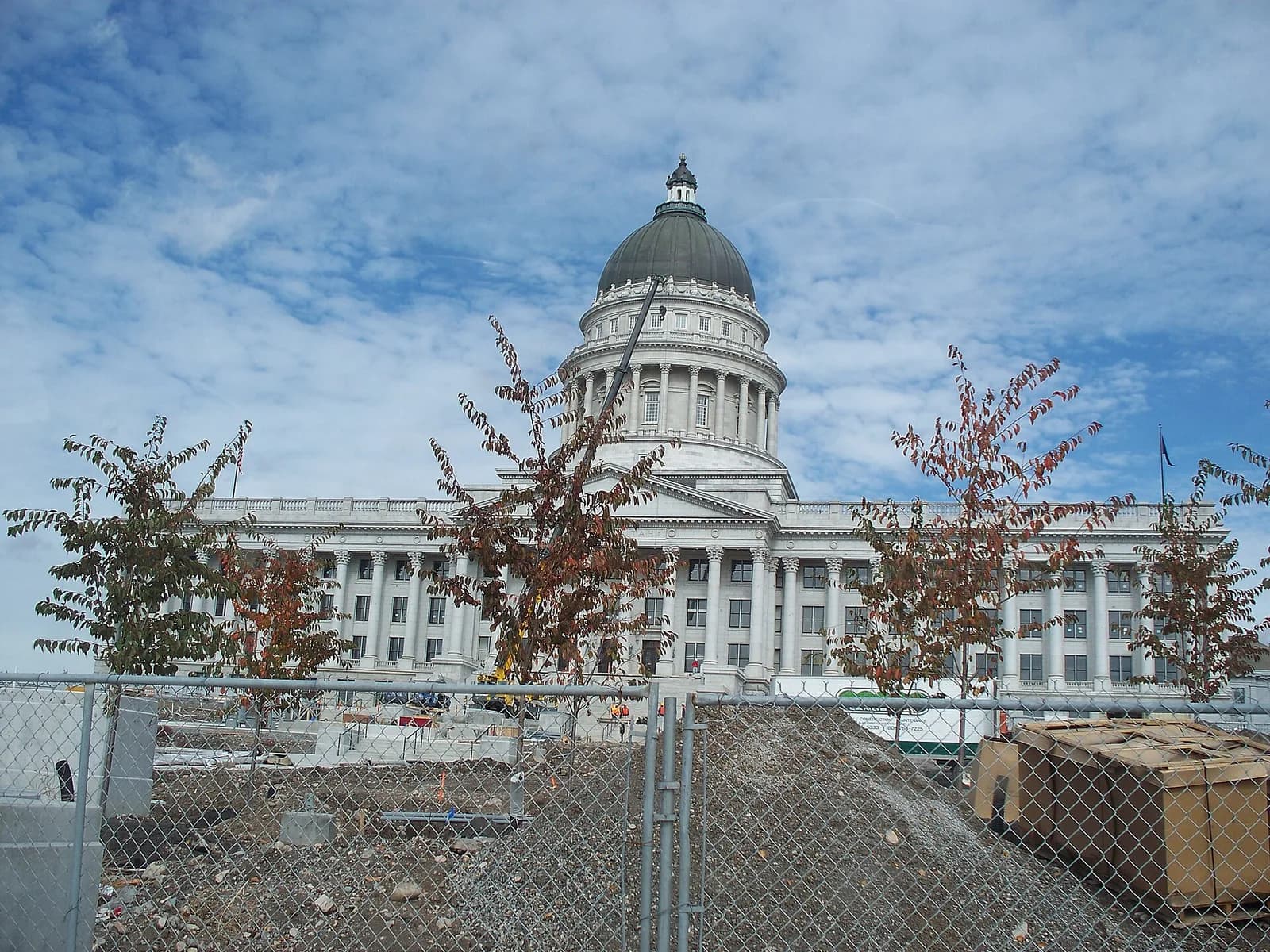
A large white neoclassical building with a prominent dome and columns is visible behind a chain-link fence and a construction site. The sky is partly cloudy with some trees in the foreground.
The Utah State Capitol complex. Shown for state policy context. Photo: Bobjgalindo / Wikimedia Commons. CC BY 4.0. Resized for display; social preview adds branding.
Titles on Utah's statewide removal list01020304050Oct 2024Oct 2025Apr 2026Aug 2026Sep 202644
Original Research by FormativeSpaces.com
The list has increased from 13 to 44 titles over two years. Sources: USBE 2024 legislative report, USBE 2025 legislative report, TownLift (April and October 2026), USBE notification. [7]

On September 28, 2026, the Utah State Board of Education sent notification to all local education agencies that seven book titles had met the statewide removal threshold under Utah Code 53G-10-103, bringing the total number of barred titles to 44, according to a USBE communication circulated through the Utah Education Network listserv. The newly added titles are "House of Earth and Blood" by Sarah J. Maas, "Identical" by Ellen Hopkins, "Kingdom of the Cursed" by Kerri Maniscalco, "Me and Earl and the Dying Girl" by Jesse Andrews, "Perfect" by Ellen Hopkins, "Storm and Fury" by Jennifer L. Armentrout, and "The Invisible Life of Addie LaRue" by V.E. Schwab.

How the statewide threshold works

Under Utah Code 53G-10-103, a title reaches the statewide removal threshold after at least three school districts, or at least two school districts and five charter schools, determine that it contains material meeting the law's objective-sensitive-material standard. The USBE flow chart says the board must notify local education agencies within 10 school days after the threshold is met. Public schools must then remove the material from student access statewide. The statewide threshold was added in 2024 through House Bill 29, following the 2022 sensitive-materials law.

TownLift's April review of the state spreadsheet found that Davis School District appeared on nearly every statewide removal then listed. Washington, Jordan, Tooele, Alpine, Nebo and Granite districts also appeared repeatedly. A statewide removal can therefore apply to a district that did not independently make the determination that triggered it. The restriction applies to public-school access; it does not prohibit private ownership or bookstore sales.

Steady growth in removals

The statewide list has grown rapidly over two years. It stood at 13 titles on October 21, 2024; 19 by October 27, 2025; 34 by late April 2026; 37 after "Push" by Sapphire was added on August 19, 2026; and 44 after the September 28 additions, according to USBE legislative reports, TownLift reporting, and the USBE notification. Of the 44 titles now removed statewide, 33 are written by women, according to Book Riot. Authors with multiple titles on the list include Sarah J. Maas (seven titles), Ellen Hopkins (six: Fallout, Tilt, Tricks, People Kill People, Identical and Perfect), and Elana K. Arnold (three). The list also includes works by Toni Morrison, Margaret Atwood, Stephen King, Judy Blume, and John Green.

75Percent of the 44 titles that are written by women [6]

Federal challenge clears a procedural hurdle

A separate federal challenge to Utah's book-removal law remains pending. In a September 15, 2026 memorandum decision, U.S. District Judge Robert J. Shelby denied the motion to dismiss the author plaintiffs for lack of standing. The court also allowed claims seeking prospective injunctive relief against individual officials to continue while dismissing other claims against those officials. This was a procedural ruling, not a decision that the book-removal law is unconstitutional.

Analysis

By the Formative Spaces Newsroom, written after the reporting above was filed.

Two districts are driving the entire statewide list, and the state board has never once overridden them.

Davis School District removed 33 of the 34 titles on the list as of May 2026, and Washington County removed 29, according to the Salt Lake Tribune. Three district determinations trigger a statewide ban, so Davis alone has been the deciding vote on nearly every removal. Davis also eliminated its cap on how many books one person can challenge per year, meaning a single parent in Farmington can file unlimited complaints that eventually bind every school in the state. The USBE has the power to overturn any statewide removal by board vote within 30 days. In September 2024, when the first 13 titles hit the threshold, the board chose not to challenge a single one. That override power has never been used.

A federal lawsuit could invalidate the entire mechanism, but no ruling on the merits is likely before mid-2027.

In Caged Bird Legacy v. Brown, filed January 6, 2026, authors including representatives of Maya Angelou and Kurt Vonnegut argue the law violates the First Amendment. Judge Shelby denied the state's motion to dismiss on September 15, 2026, letting the author plaintiffs and prospective injunction claims proceed. The case took roughly six months just to resolve the standing question. Discovery and summary judgment briefings will take months more. Parents should watch for a summary judgment ruling, which would be the first time a court addresses whether the law itself is constitutional. Nothing on the court docket sets a trial date yet.

Utah is one of three states with a statewide ban mechanism, and its aggregation design is the most aggressive.

PEN America identifies only three states that enacted statewide school book ban mechanisms in 2024: Utah, South Carolina, and Tennessee. Tennessee's law has not been used to remove any books. South Carolina's regulation gives the state Board of Education direct authority to ban titles, a top-down approach. Utah's is distinctive because it aggregates local district decisions into a statewide mandate, meaning a book can disappear from every public school in the state without most districts ever reviewing it. PEN calls Utah's law the most extreme state book-banning measure currently in effect. No other state has copied this aggregation design since.

Sources

  1. Utah Education Network listserv. Fw: New titles to be removed from Utah public schools View
  2. TownLift. Utah adds seven books to statewide school removal list, bringing total to 44 View
  3. Utah State Board of Education. Sensitive Materials Flow Chart, Checklist and Definitions View
  4. Utah State Board of Education. Library Media - USBE View
  5. TownLift. Utah's statewide book removal list hits 34 as two more titles are pulled View
  6. Book Riot. Utah Bans 7 More Books From All Public Schools; 44 Titles Now Banned Statewide View
  7. Utah State Board of Education. 2024 Sensitive Instructional Materials Legislative Report View
  8. Utah State Board of Education. 2025 Sensitive Instructional Materials Legislative Report View
  9. U.S. District Court for the District of Utah (via ACLU of Utah). Caged Bird Legacy, LLC v. Brown, No. 2:26-cv-00010, Document 126, memorandum decision and order (September 15, 2026) View
  10. Salt Lake Tribune. Nearly all Utah book bans originate from just 2 school districts, Tribune finds View
  11. Salt Lake Tribune. Utah State Board chooses not to overturn public school book bans View
  12. KUER. After the Bible controversy, Davis School District updates its book challenge policy View
  13. Standard-Examiner. Davis school officials have pulled 33 books from libraries under new policy View
  14. Courthouse News Service. Caged Bird Legacy v. Brown, No. 2:26-cv-00010, memorandum decision and order (September 15, 2026) View
  15. Salt Lake Tribune. Authors can still sue Utah over state's school book ban, federal judge rules View
  16. PEN America. PEN America Index of School Book Bans – 2024-2025 View