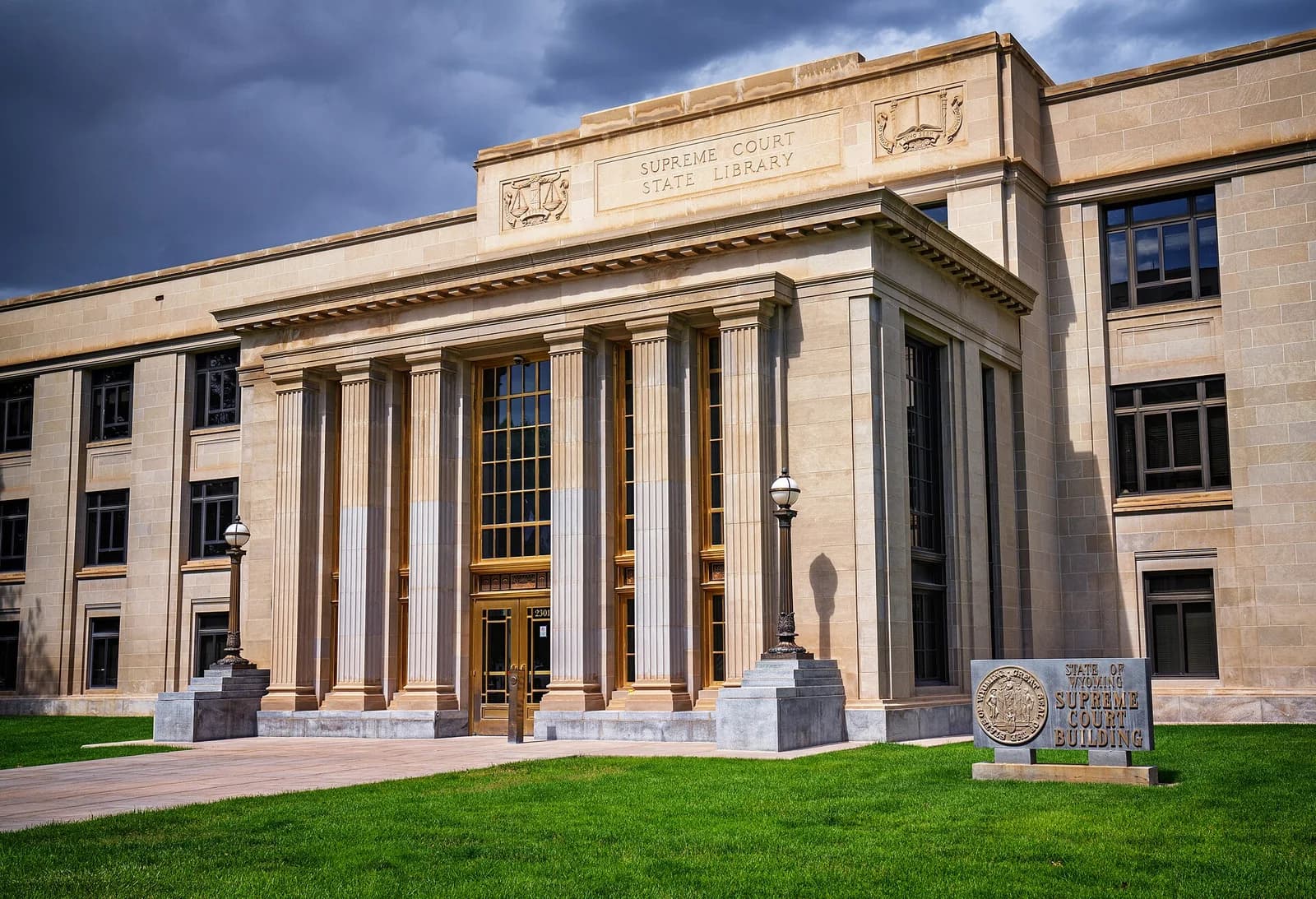
On September 17, 2026, the Wyoming Supreme Court ruled that the legislature violated students' equal protection rights by failing to fund the true cost of teacher salaries and by skipping legally required inflation adjustments, while reversing the lower court's orders to mandate funding for one-to-one technology, nutrition services, and school resource officers. The ruling, issued in State v. Wyoming Education Association (2026 WY 99), was written by Chief Justice Lynne Boomgaarden and joined by Justices John Fenn and Robert Jarosh.
Core violations affirmed
The court affirmed by majority the district court's finding that the legislature underfunded teacher salaries. Salary data cited in the opinion showed the model's base salary was $37,017 in 2010 and $37,820 in 2022, and weighted average model salaries moved only from $53,046 in 2010-11 to $53,506 in 2022-23. In 2022-23, actual average teacher salaries exceeded model average salaries by about 16 percent, the largest gap since the current funding model was adopted, according to the opinion.
The court also affirmed that the legislature violated equal protection by failing to follow precedent and state statute on external cost adjustments, which require yearly evaluations and appropriate action to address inflation. The justices rejected the State's argument that ECAs were discretionary, holding that the mandatory statutory language requires cumulative inflation adjustments when inflationary pressures are present.
A labor market consultant's 2023 monitoring report to the legislature, cited by the court, found that Wyoming teacher salaries were 3 percent below the regional average, that average weighted model salaries were about $8,000 below the U.S. actual average, and that exit rates for new and midcareer teachers were the highest rates recorded in Wyoming. This evidence supported the district court's finding that the model's personnel cost estimate no longer reflected true costs.
Reversals on technology, nutrition, and school security
The Wyoming Supreme Court reversed the district court's order requiring one-to-one technology funding, finding the issue was not raised by the pleadings and not tried by consent of the parties. The court also reversed the requirement to fund nutrition services and school resource officers as innovations, holding that the plaintiffs did not meet their burden of showing that these innovations require statewide funding under Wyoming precedent.
The court reversed the district court's order requiring a statewide assessment of school facilities for educational suitability, finding that the School Facilities Commission Rules, Chapter 3, section 8 provides a constitutionally sound mechanism and that the State has discretion to establish its own evaluation process.
No deadline or retained jurisdiction
The justices did not set a compliance deadline and did not retain jurisdiction to monitor compliance, departing from the district court's original order. They wrote that they would presume lawmakers act in good faith and noted that plaintiffs could bring future legal action if compliance is not achieved.
This approach contrasts with the state's earlier school finance litigation. In Campbell II (2001), the Wyoming Supreme Court ordered the legislature to make required modifications to the funding model by July 1, 2002, and directed the district court to retain jurisdiction until the legislature complied. In Campbell IV (2008), the court declared the legislature had enacted statutes for funding school operations and facilities that complied with constitutional requirements, concluding a litigation cycle that began in the 1990s. The current ruling leaves the legislature's next recalibration session as the practical test of compliance, without a court-ordered timeline.
Dissenting opinion
Justice Kari Gray filed a concurring in part and dissenting in part opinion, joined by District Judge Joshua Eames (sitting for recused Justice Bridget Hill). Gray wrote that she would reverse the district court's decision in its entirety, disagreeing with the majority's reasoning as exceeding the judicial role.
The State's funding model and the gap
Dr. Lori Taylor, an expert in education and public finance retained by the State for ECA assessments, confirmed that the purpose of an ECA is to adjust funding for changes in the cost of providing educational services and that an ECA must be applied cumulatively every year inflation is present. She also advised during the 2010 recalibration that the Legislative Model would remain adequate without additional ECAs, a determination that led the legislature to decline ECAs from 2010-11 through 2013-14.
Unchallenged holdings and legislative context
The State did not appeal the district court's findings that it must include funding for elementary school counselors in the funding model and that the legislature was failing to properly address necessary capital construction. Those unchallenged holdings remain in effect.
A 2026 school funding recalibration bill became law without Gov. Mark Gordon's signature. The governor said it disadvantaged smaller districts, usurped local authority, and failed to address essential operational funding needs. A legislator involved said the ruling validates that bill, meaning no additional funding would be required for technology, nutrition, and SROs.