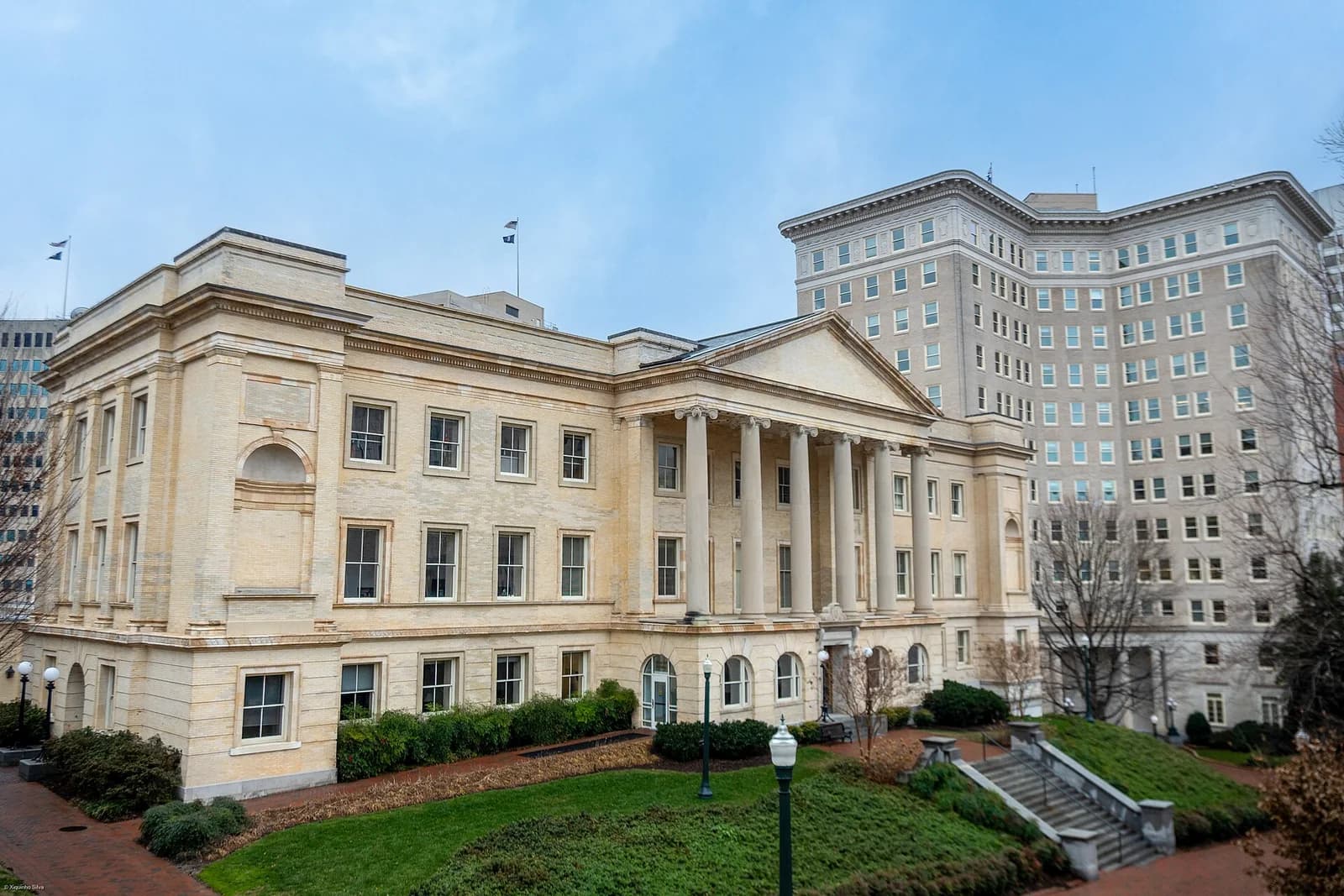
On October 5, 2026, the U.S. District Court for the Eastern District of Virginia ruled that Virginia's 2020 tuition equity law and its domicile-based tuition statute are not preempted by federal immigration law. Senior U.S. District Judge Robert E. Payne granted the state's motion for summary judgment and dismissed with prejudice a lawsuit filed by the U.S. Department of Justice in December 2025, according to the court's memorandum opinion in United States v. Commonwealth of Virginia [1].
The court examined two pathways to in-state tuition. The domicile pathway, under Va. Code §§ 23.1-502 and 23.1-503, does not provide benefits to undocumented students because SCHEV's published guidelines state that students unable to present valid immigration documentation cannot demonstrate domicile, according to the agency's documentation and reporting by Courthouse News Service [2][6]. The tuition equity pathway, enacted in 2020 as HB 1547, offers in-state tuition to students who attended a Virginia high school for at least two years, graduated or passed an equivalency exam on or after July 1, 2008, and whose parent or guardian filed Virginia income tax returns for at least two years, according to the legislation [5]. The court held that this pathway is not residence-based, and that even if it were, the federal statute's exception applies because the law grants benefits to a citizen, meaning one or more citizens, not all. The opinion also noted other pathways for non-resident citizens, such as the Academic Common Market and the Thirty-Mile Radius pathway [1].
A split with Texas and Illinois
The Virginia ruling stands in contrast to two recent decisions. The Fifth Circuit, in United States v. Texas, affirmed on July 9, 2026, a judgment that Texas's Dream Act was preempted because it tied eligibility to residence or domicile [7]. The Southern District of Illinois similarly struck down that state's laws on July 24, 2026 [1]. The Virginia court distinguished both cases on the grounds that those laws explicitly tied eligibility to residence or domicile, while Virginia's tuition equity pathway does not [1].
The DOJ complaint in United States v. Texas states that approximately 56,500 undocumented students were enrolled in a Texas school for higher education in 2022 [9]. A separate estimate from the Presidents' Alliance on Higher Education and Immigration, cited in news reporting, places the figure at about 57,000 [10]. The Fifth Circuit opinion does not independently cite an enrollment figure [7].
The court also cited a Minnesota ruling, United States v. Walz, 825 F. Supp. 3d 897 (D. Minn. 2026), which upheld that state's tuition law on similar reasoning, according to the Virginia opinion [1]. Legal observers quoted by Inside Higher Ed say the conflicting decisions could lead the Supreme Court to review the question of whether these state laws are preempted by 8 U.S.C. § 1623(a). DOJ has filed about 25 additional lawsuits against other states' tuition laws, according to the same report [3].
What the research suggests
A 2020 report from the American Immigration Council, published before Virginia enacted its law, reviewed existing studies and found that Latino non-citizens in states with in-state tuition policies were 31 to 54 percent more likely to be enrolled in higher education than peers in states without such policies [8]. The report also found that these policies reduced high school dropout rates among certain immigrant students by as much as 14 percent, and estimated that over 3,700 Virginia students could benefit from a tuition equity policy [8]. The report noted that the findings come from observational comparisons and may not establish causation [8].
The Virginia ruling leaves the legal landscape uneven. While the Fifth Circuit has struck down Texas's law, and an Illinois district court did the same, the Eastern District of Virginia and a Minnesota district court have upheld theirs. The question of whether state tuition-equity laws that avoid explicit residency language survive federal preemption is now positioned for possible Supreme Court review, according to reporting by Inside Higher Ed [3].