AI in Schools / The Visual Edition / Story 09
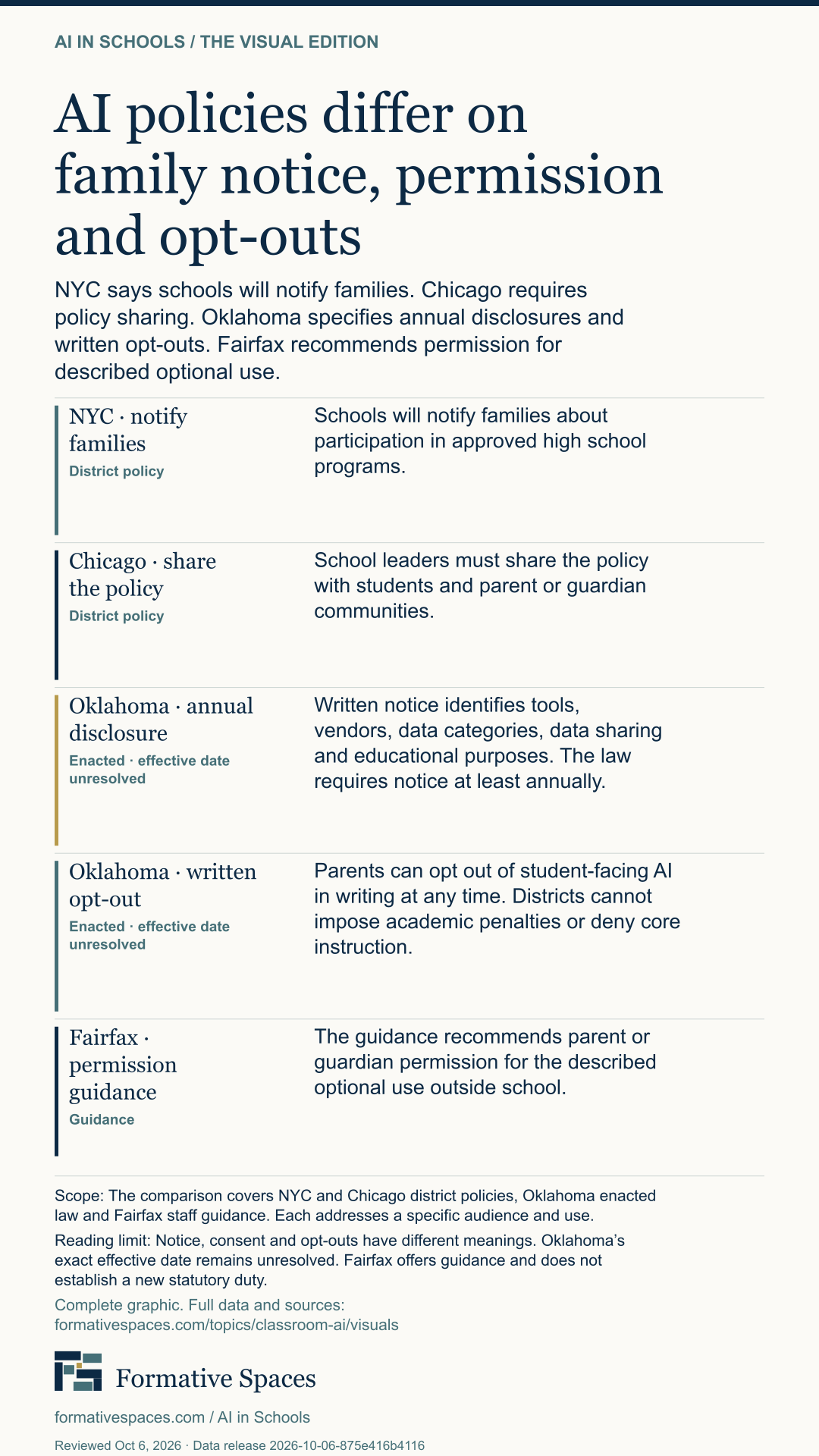
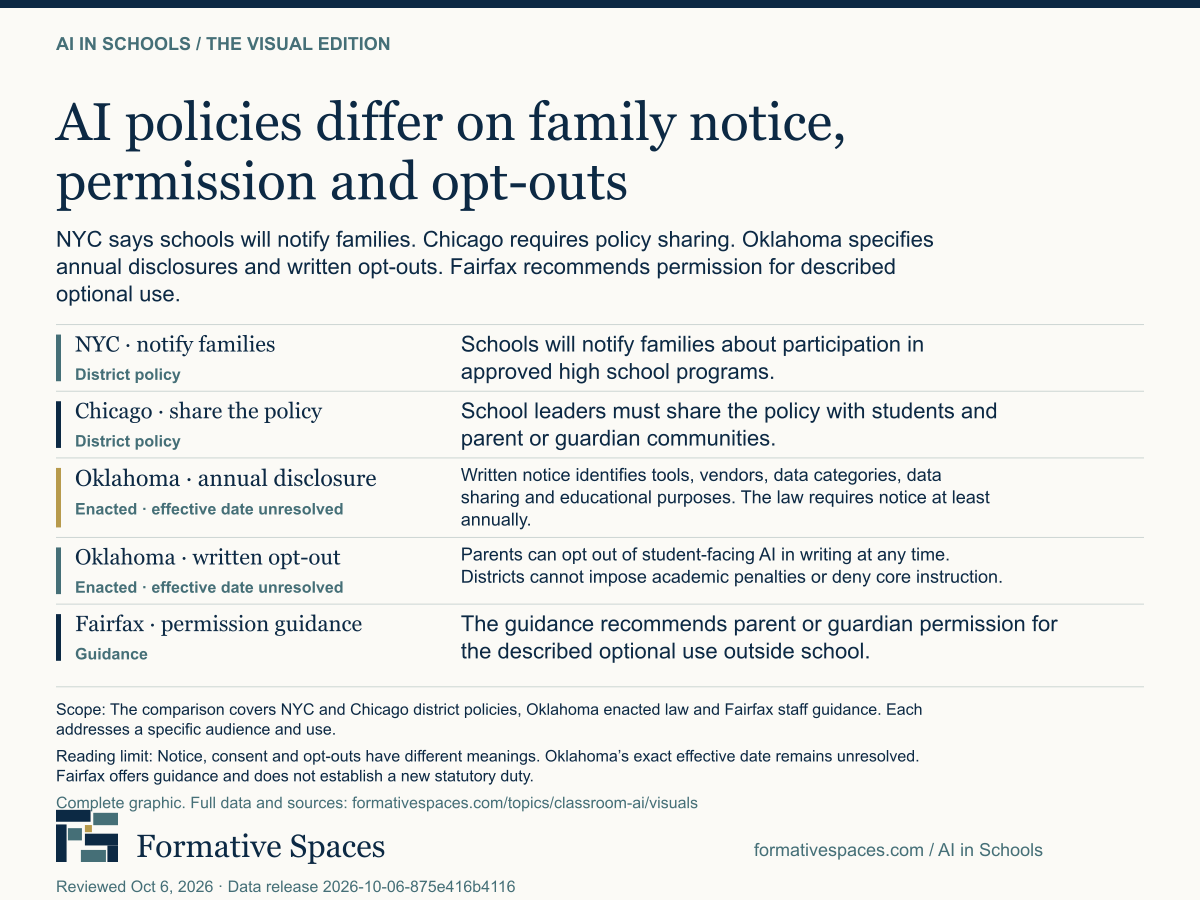
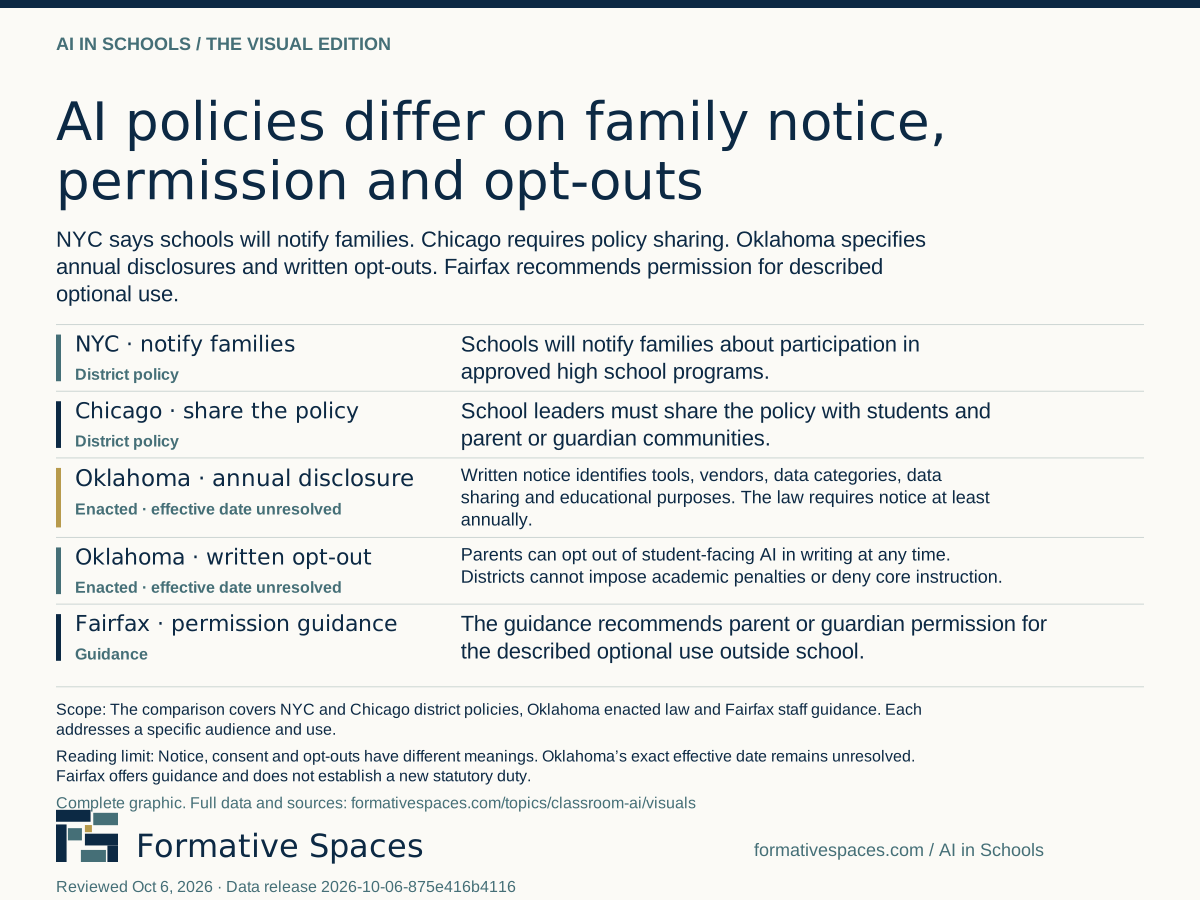
AI policies differ on family notice, permission and opt-outs
NYC says schools will notify families. Chicago requires policy sharing. Oklahoma specifies annual disclosures and written opt-outs. Fairfax recommends permission for described optional use.
Formative Spaces · Research reviewed October 6, 2026
Key findings
NYC says schools will notify families about approved high school programs. Chicago requires school leaders to share its acceptable-use policy. Those notices alone do not establish consent requirements for every AI use.
Oklahoma requires written disclosure at least annually and allows written opt-outs from student-facing AI at any time. Opt-outs cannot cause academic penalties or denial of core instruction. Fairfax recommends family permission for the described optional use outside school.
Animated chart
Eight-second animation
The animation shows the same data as the chart. Use the controls to play, pause or expand the video.
Download and share
Each download includes the Formative Spaces name, brandmark and source context. Share the complete graphic. Include a link to this story. Site terms apply. Original policy sources retain their own rights.
Still graphics
Landscape PNG 1200 × 900Square PNG 1080 × 1080Vertical PNG 1080 × 1920Scalable SVG Full graphic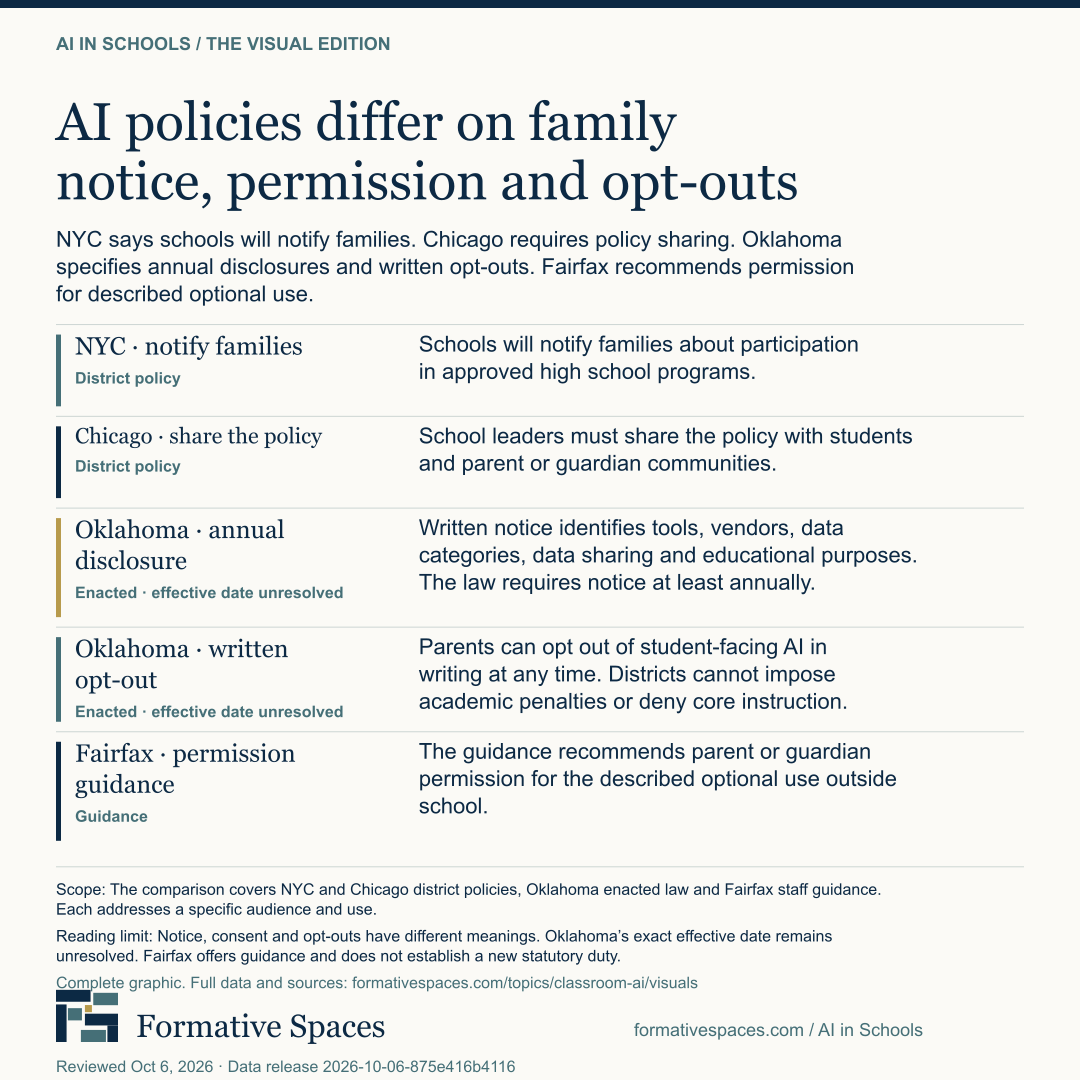
Animations
Landscape MP4 8 seconds · silentVertical MP4 8 seconds · silentAnimated SVG Reduced-motion aware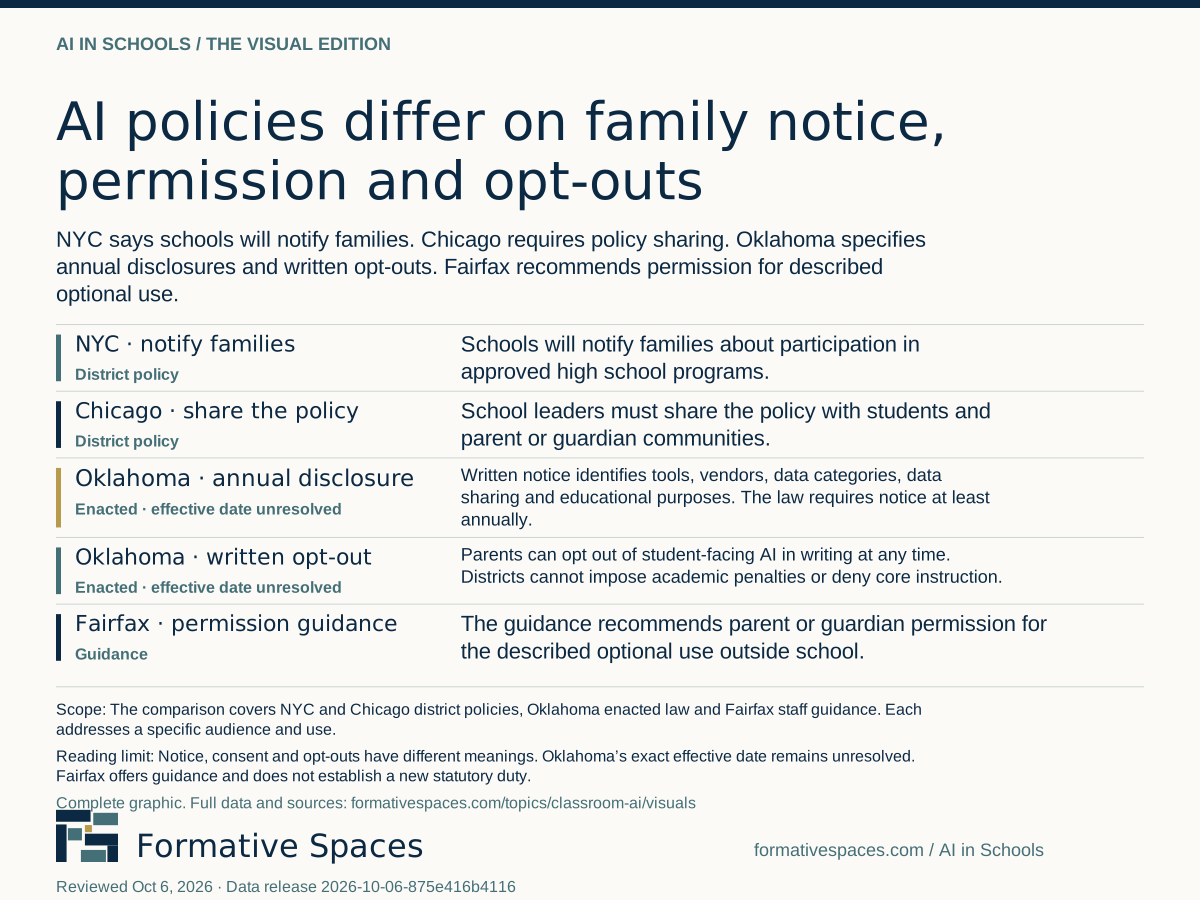
PNG and MP4 files can be uploaded to social platforms. Available sharing destinations depend on your device and the platform.
Chart data and sources
selected obligations and guidance. The comparison covers NYC and Chicago district policies, Oklahoma enacted law and Fairfax staff guidance. Each addresses a specific audience and use.
| Document and family action | Scope | Evidence |
|---|---|---|
| NYC · notify familiesDistrict policy | Schools will notify families about participation in approved high school programs. | New York City Public Schools: Student-facing AI and screen-time policyProvision references
|
| Chicago · share the policyDistrict policy | School leaders must share the policy with students and parent or guardian communities. | Chicago Public Schools: Student Acceptable UseProvision references
|
| Oklahoma · annual disclosureEnacted · effective date unresolved | Written notice identifies tools, vendors, data categories, data sharing and educational purposes. The law requires notice at least annually. | Oklahoma: Responsible Technology in Schools ActProvision references
|
| Oklahoma · written opt-outEnacted · effective date unresolved | Parents can opt out of student-facing AI in writing at any time. Districts cannot impose academic penalties or deny core instruction. | Oklahoma: Responsible Technology in Schools ActProvision references
|
| Fairfax · permission guidanceGuidance | The guidance recommends parent or guardian permission for the described optional use outside school. | Fairfax County Public Schools: AI guidance for faculty and staffProvision references
|
Notice, consent and opt-outs have different meanings. Oklahoma’s exact effective date remains unresolved. Fairfax offers guidance and does not establish a new statutory duty.
Sources & Notes
- Guidance on Artificial Intelligence and Screen Time
New York City Public Schools · Source checked October 6, 2026
- Grades 9–12: Student-Facing AI Use
- Student Acceptable Use | Chicago Public Schools
Chicago Board of Education · Source checked October 6, 2026
- Purpose
- Responsible Technology in Schools Act — official document
Oklahoma Legislature · Source checked October 6, 2026
- §1(F)
- §1(G)
- Bill Information
Oklahoma Legislature · Source checked October 6, 2026
Official SB 1734 bill history
Reviewed record and version → - Artificial Intelligence Guidance for FCPS Faculty and Staff | Fairfax County Public Schools
Fairfax County Public Schools · Source checked October 6, 2026
- Communicate Clear Expectations for AI Use
Release and evidence identity
Research release 2026-10-06-875e416b4116. Headlines and comparisons use this reviewed release. A changed record requires a new editorial review.
Source projection SHA-256: 9cd6a4996022129f1a1a1060c399a65f12c8f18bc7774fea67463c4d0dd981eb
- nyc-ai-2026-27 / q13:
8065ca4c14e4a4c2006240db676bac63657eb202ff7ea09c1c1705a2dacb00f2 - chicago-student-acceptable-use / q14:
0bc94b24b21ddd1237c6355021901d774f301ae730fa81b69d2ec033789a881d - oklahoma-responsible-technology / ok_sb1734_enrolled:
a2a33057c3fbeaf1f165a6a28500b0438382aa95a54eca6d5cdf638b589baefc - oklahoma-responsible-technology / ok_sb1734:
e28a8f07aaeffb74b21a37e8f0581072943b6b4949110963dc41461094d395b3 - fairfax-staff-ai-guidance / fcps_staff:
dcc831708832f1170da72493551cf82097cbc03da01ce86b65a4fd5875a3918f
Public policy data for this release (JSON) · Collection and coverage notes
Citation
Formative Spaces, “AI policies differ on family notice, permission and opt-outs,” AI in Schools: The Visual Edition, research release 2026-10-06-875e416b4116, reviewed October 6, 2026. https://www.formativespaces.com/topics/classroom-ai/visuals/family-notice-is-not-one-thing