AI in Schools / National analysis
Who Sets the Rules for Classroom AI
State law, district approval and teacher permission can set separate limits on classroom AI. Family choices and human-review requirements also vary.
Published
Research as of · Sources & Notes
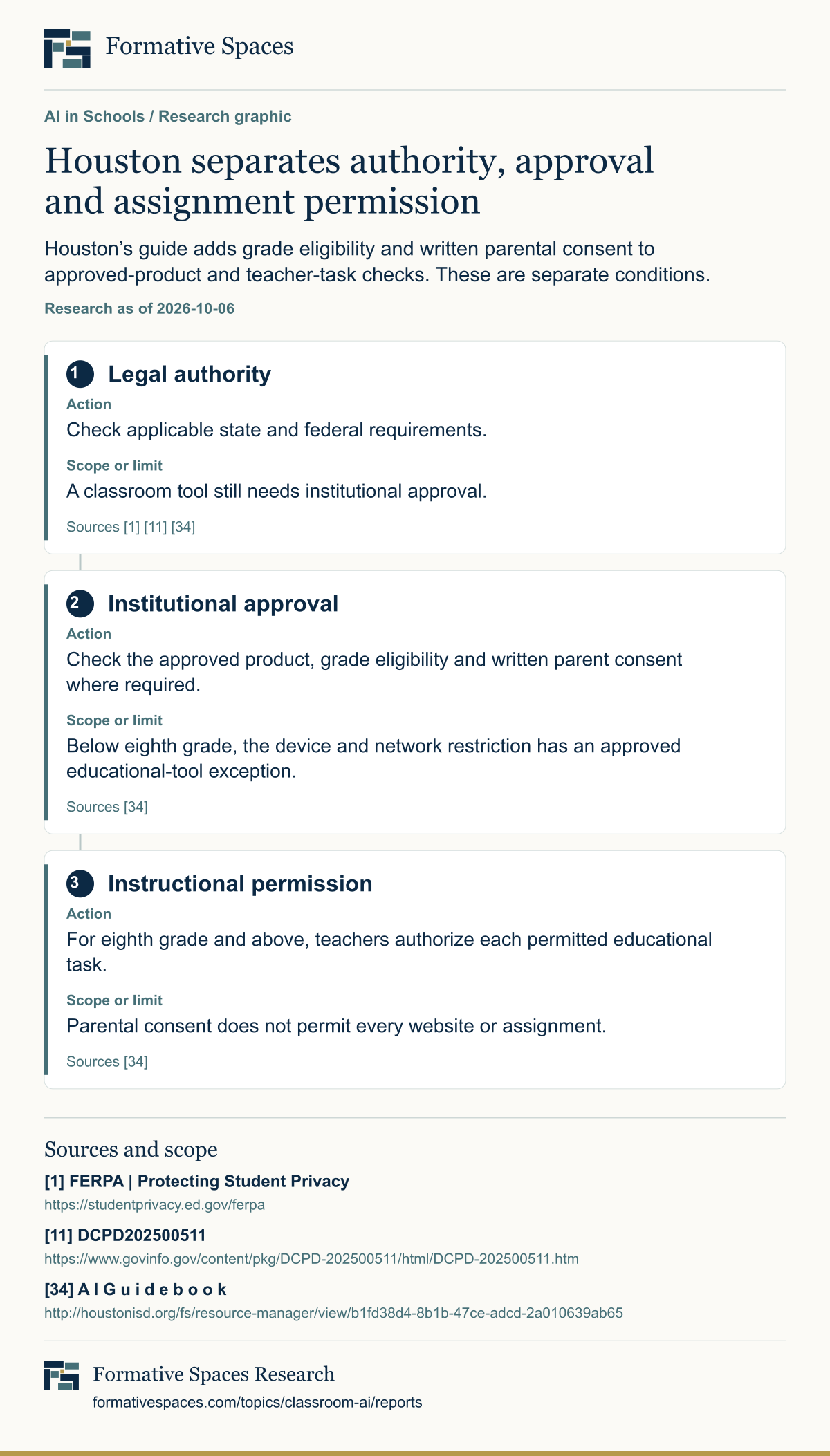
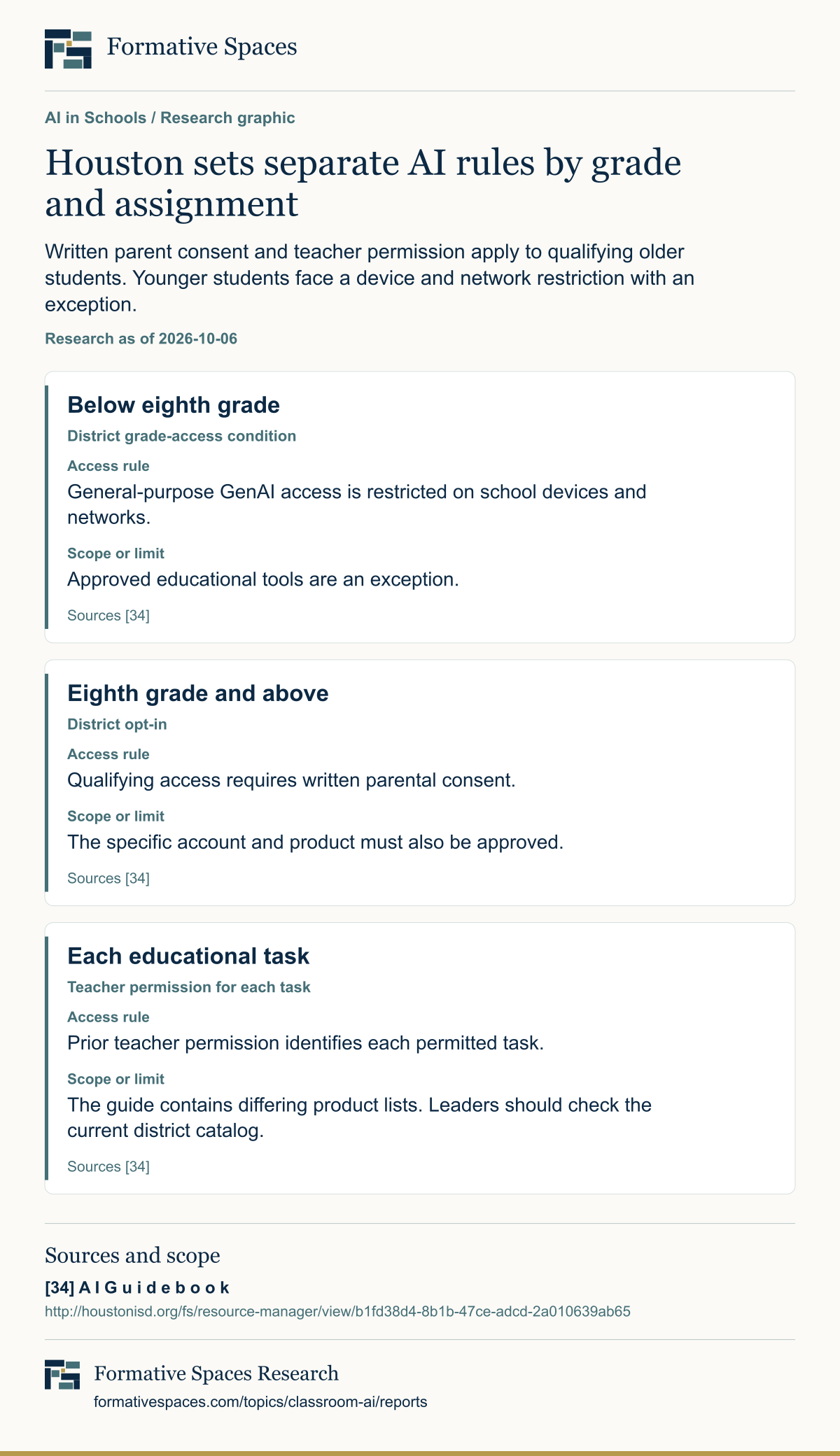
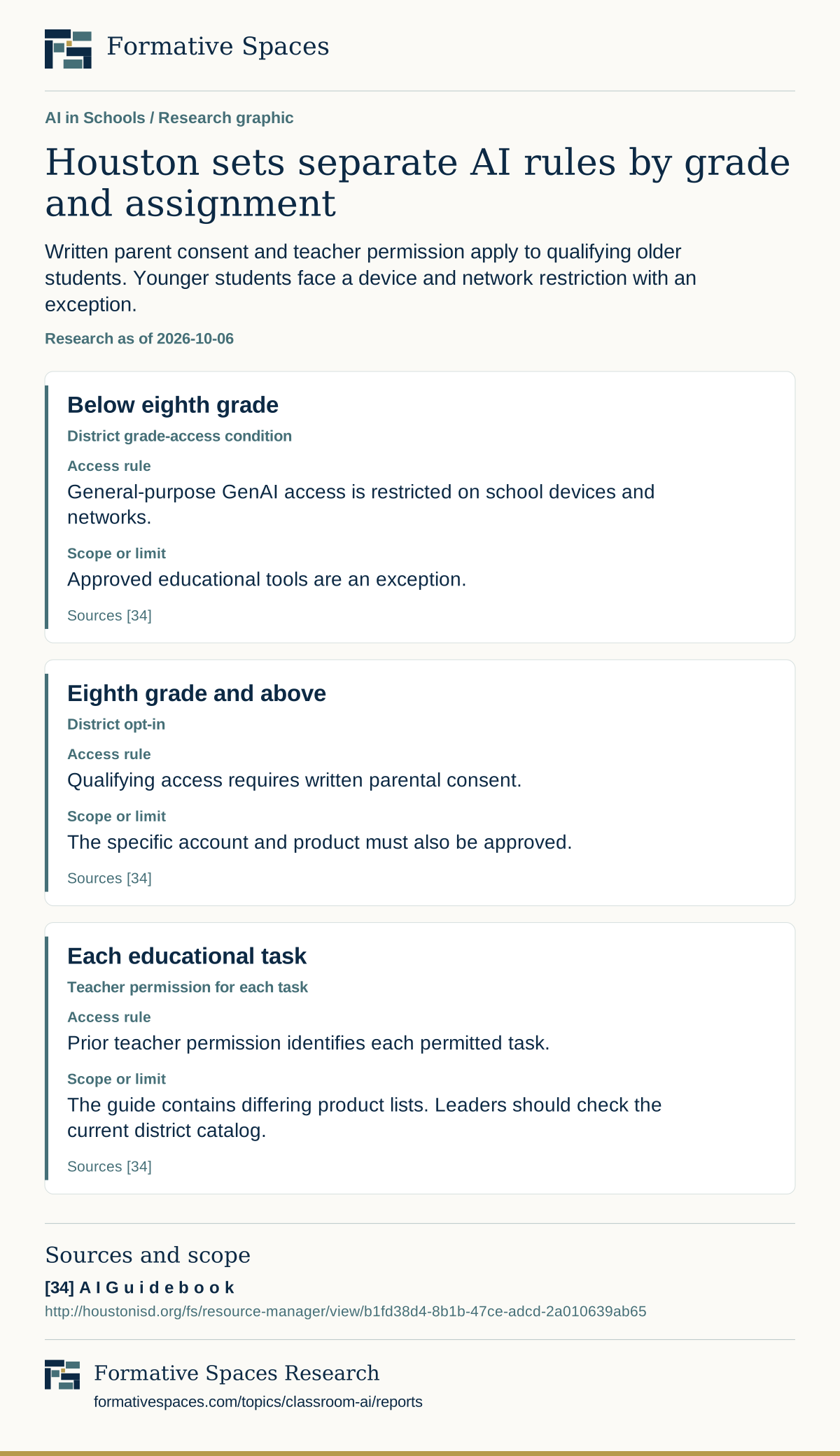
In Houston, a parent’s written permission is only one part of a student’s access to classroom AI. The district’s January 2026 guide requires that consent for students in eighth grade and above. Their teacher must also permit each approved educational task. A family can agree to an account while the teacher still limits its use on a particular assignment. The district’s product review adds another condition before either decision. 34
Younger students face a different starting point. Houston restricts access to general-purpose generative AI on school devices and networks below eighth grade, with an exception for approved educational tools. That distinction matters when a family hears that the district allows AI. The permission depends on the student’s grade, the tool and the task. The guide also contains differing product lists, so families and teachers need the current approved list before relying on a named service. 34
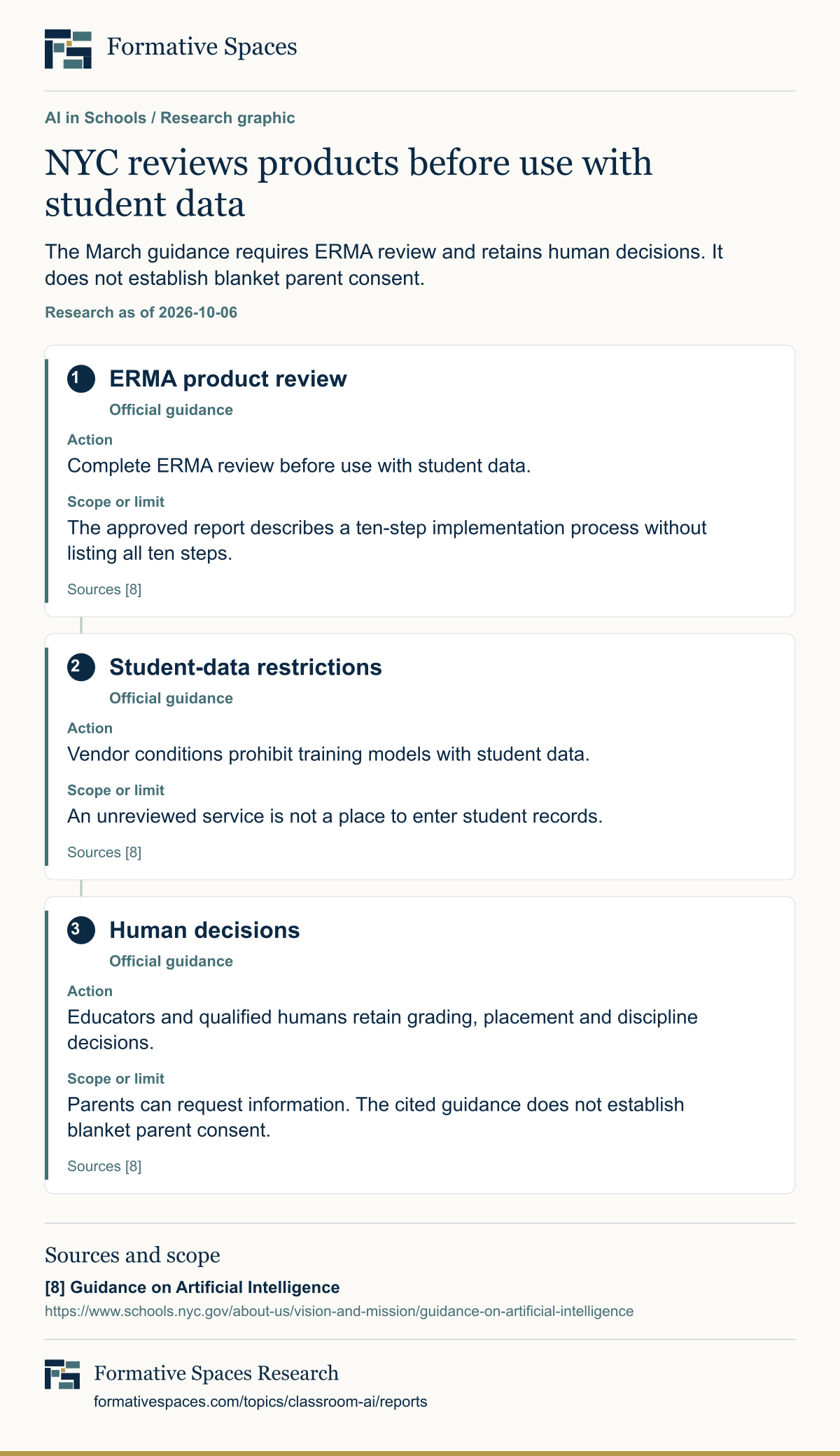
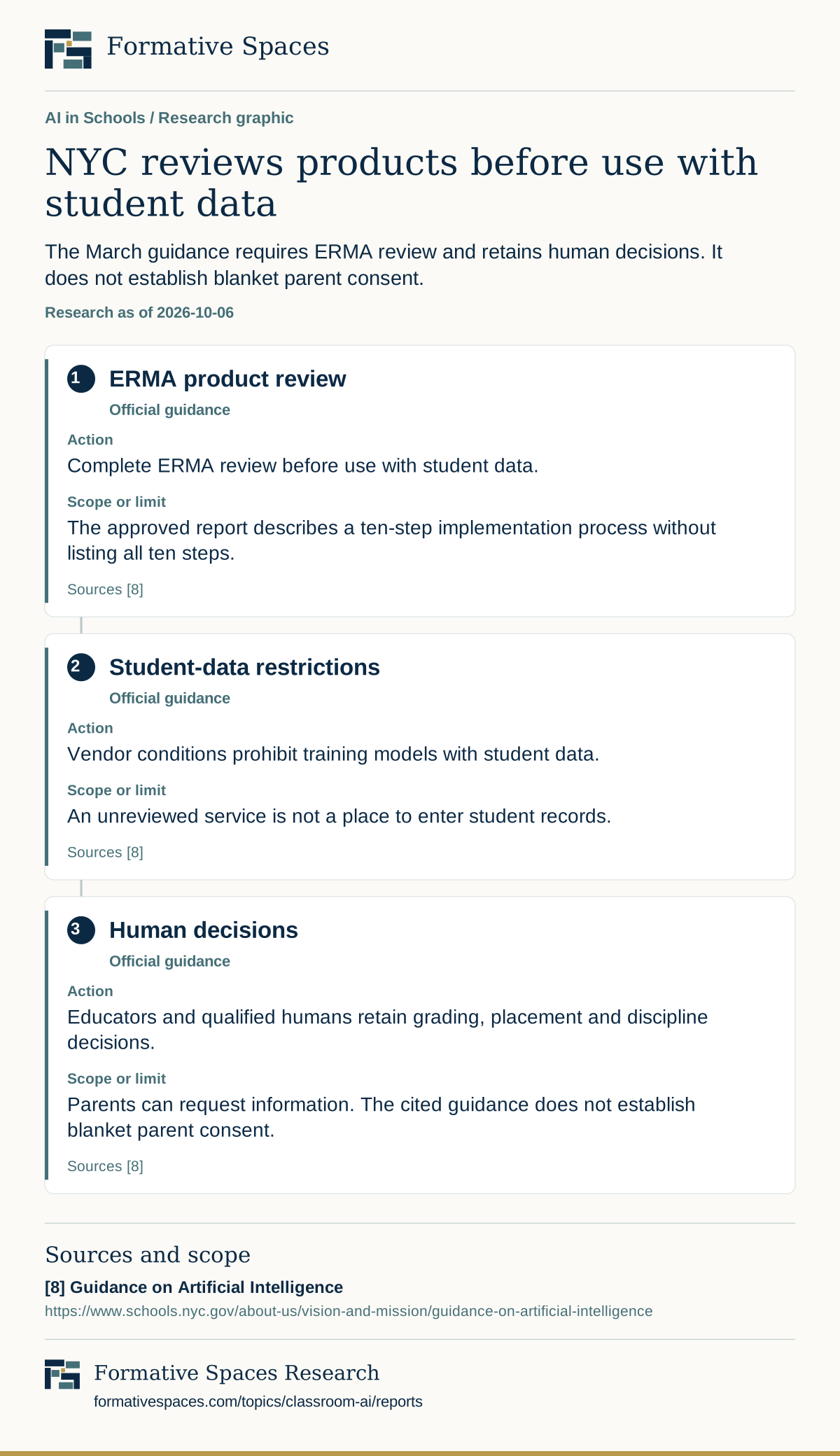
New York City’s March 2026 guidance puts product review at the center of the decision. Its ten-step ERMA process reviews tools before school use, including requirements for vendors handling student data. Vendors cannot train AI models with that data. The guidance also reserves grading, placement and discipline decisions for educators and other qualified humans. Parents can request information about a tool. This cited guidance does not establish a blanket parent-consent requirement. 8
The two districts ask different questions before a student can use AI. Houston’s guide connects access to grade, written consent and teacher permission for the task. New York City’s guidance connects it to institutional review, data safeguards and human decisions. Neither document makes a state label sufficient to approve a classroom chatbot. 8 3444
The August 23, 2026 tracker gives a wider view of these overlapping decisions. Across 51 state jurisdictions, including DC, it classified nine as having classroom-AI laws, 30 as having guidance and 12 as having no statewide rule. Eight of its state rules required local policies. It also documented 82 district policies, without claiming a district census. These dated counts describe policy categories in that tracker. They cannot tell a family whether a particular school currently permits a particular tool. 7
30 of 51 jurisdictions had AI guidance in August53

Districts still decide which tools students can use
The policy chain starts above the district, but it does not end there. The federal executive order of April 23, 2025 promotes AI literacy and federal education initiatives. It does not approve an individual classroom chatbot. Federal protections for student records still apply. State lawmakers and agencies can then set duties for policy, notice, training or oversight. Districts make product and account decisions within those protections, while teachers set the terms of an assignment. 1 11 4 8 34
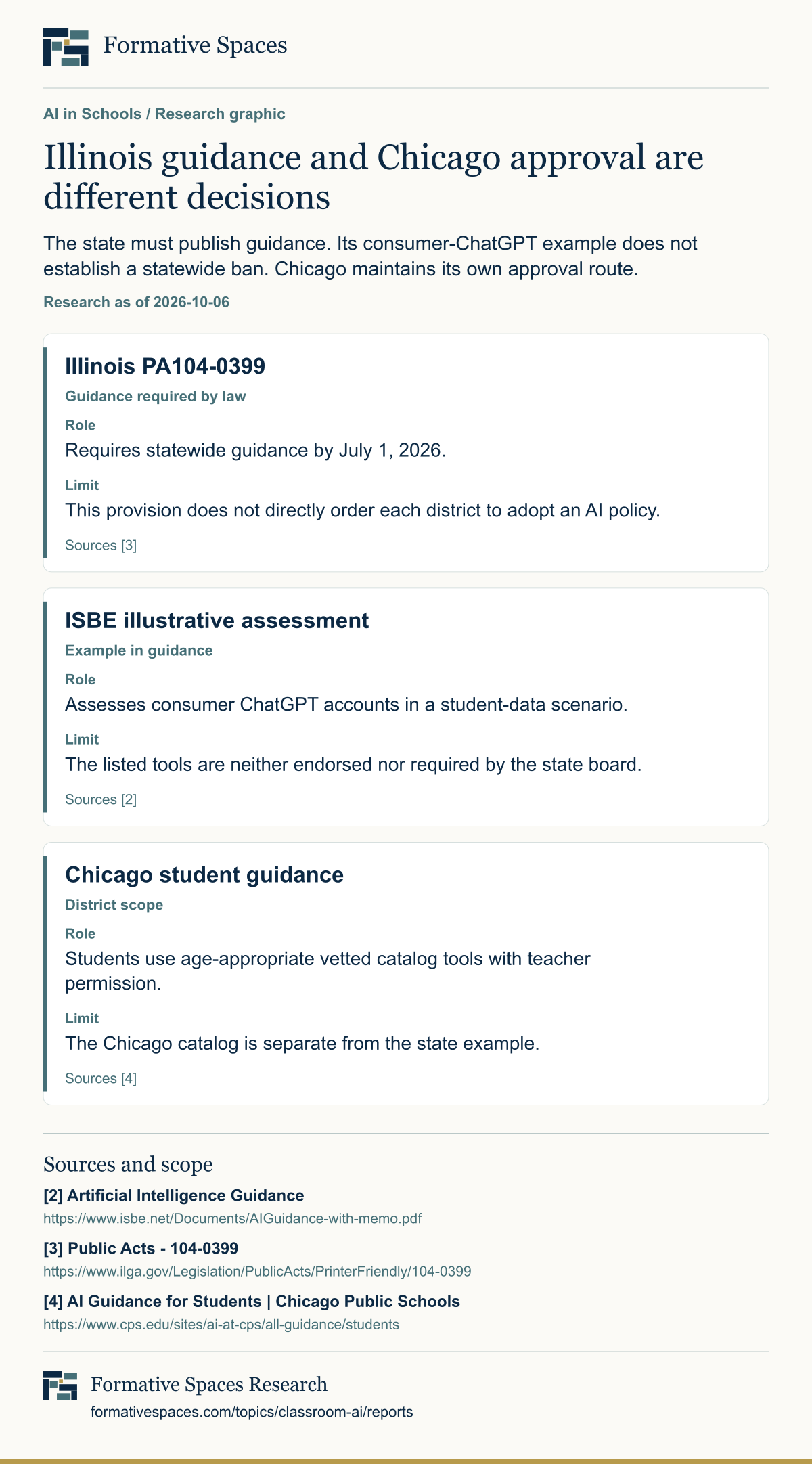
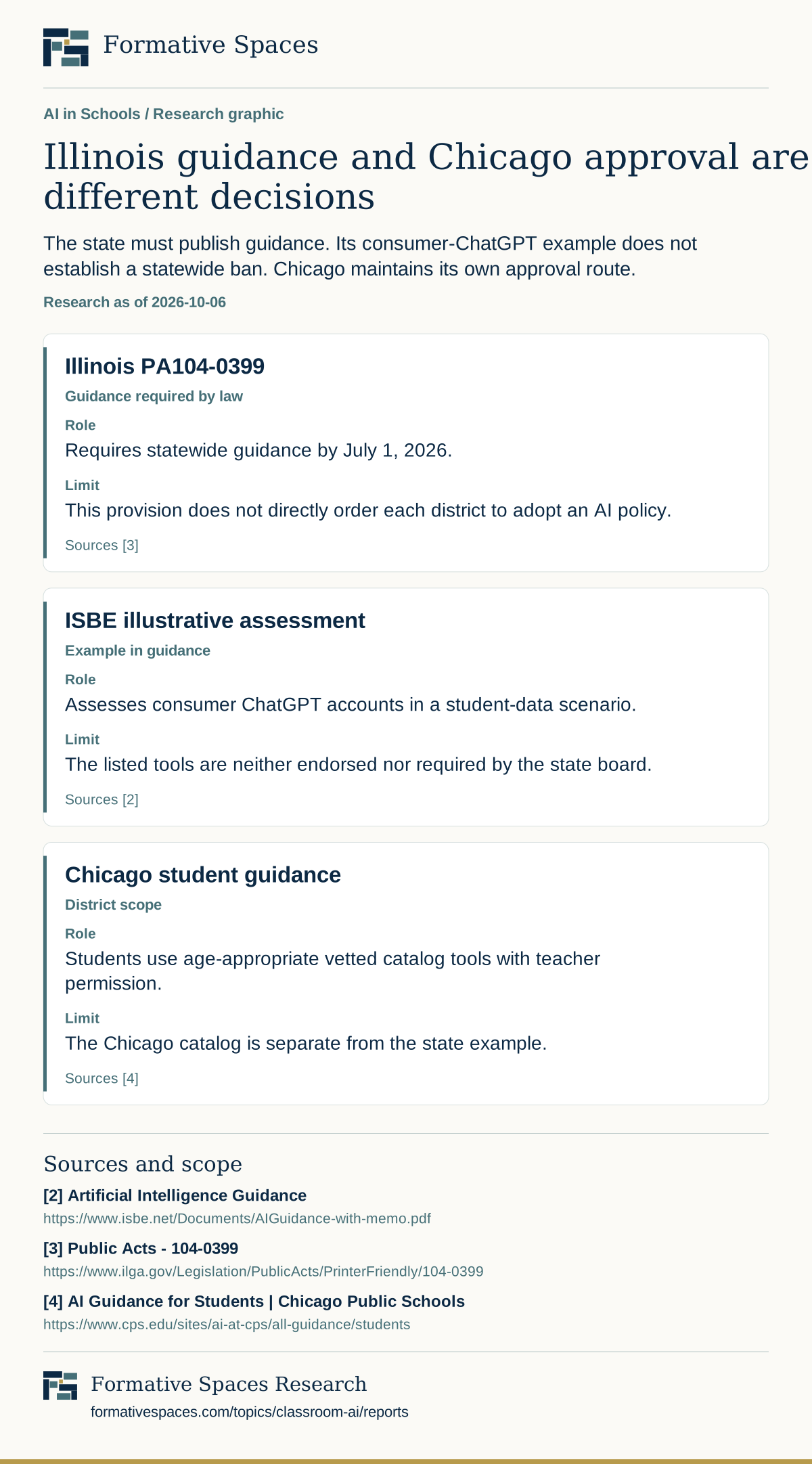
Illinois shows why the kind of state document matters. Its law required the state board to issue guidance by July 1, 2026, and guidance appeared in June. That provision did not directly require each district to adopt an AI policy. An illustrative resource marks consumer ChatGPT accounts “Not Approved” in a student-data scenario. The resource also disclaims statewide endorsement or requirements for the listed tools. Turning that example into a statewide product ban would change its meaning. 2 3
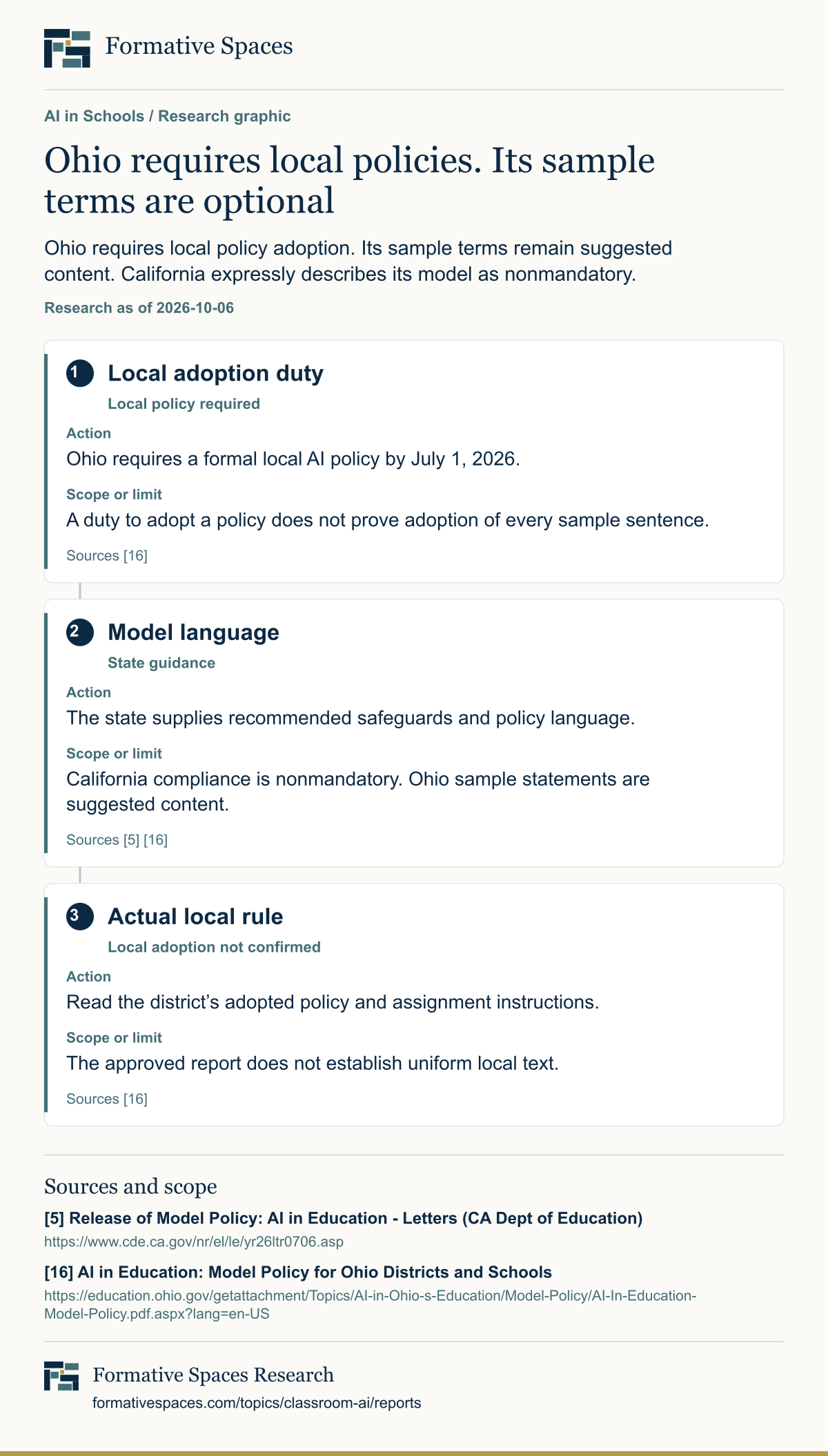
Ohio requires a different action. Traditional districts, community schools and STEM schools had to adopt a formal AI policy by July 1, 2026. The state model offers sample language about privacy and student work. Those suggested terms do not prove that every local board adopted the same policy. For a student, the consequential document is the version adopted by the school. For a teacher, that document connects the state requirement to the actual assignment and tool rules. 16
State AI policy alone does not approve a classroom tool54

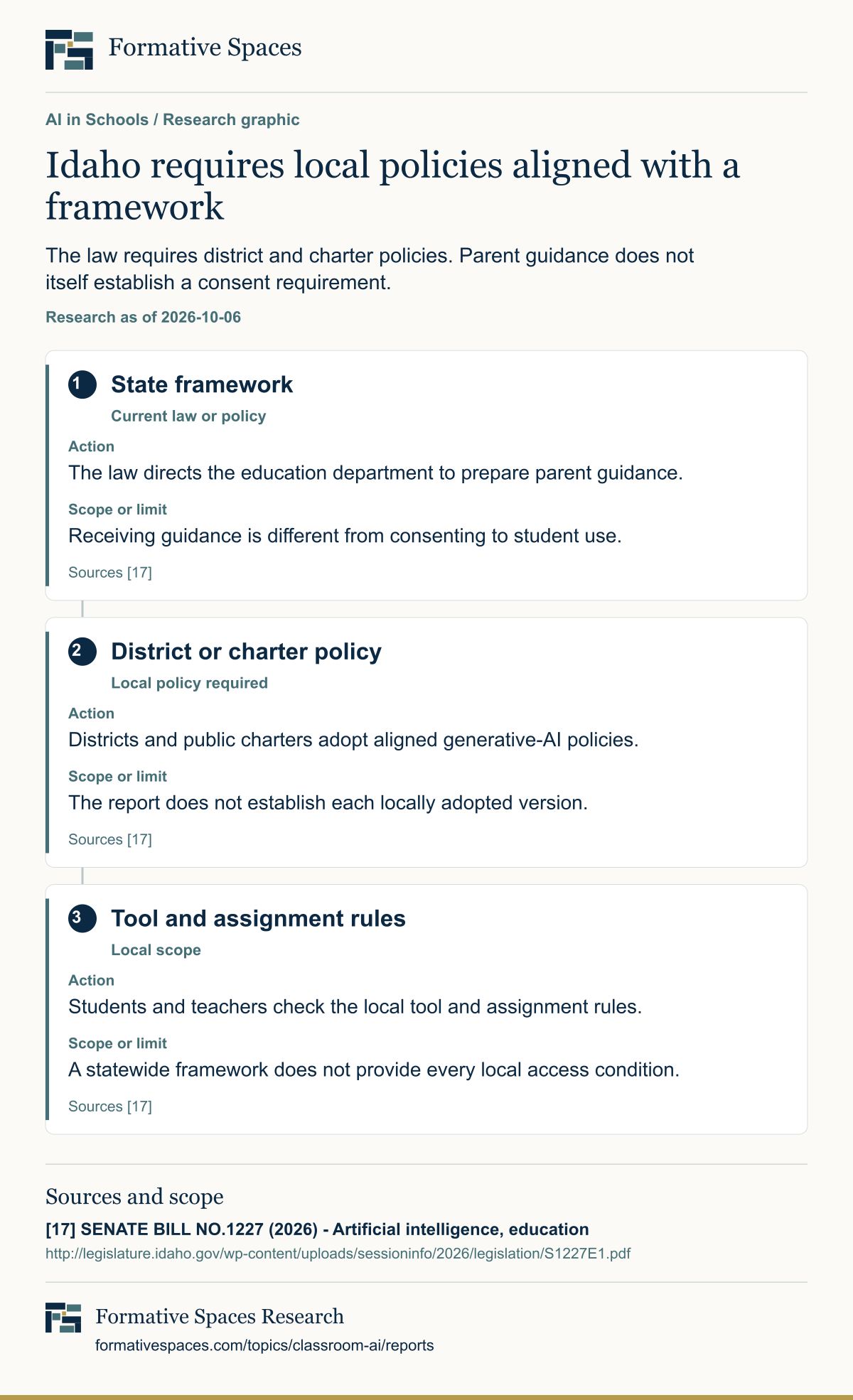
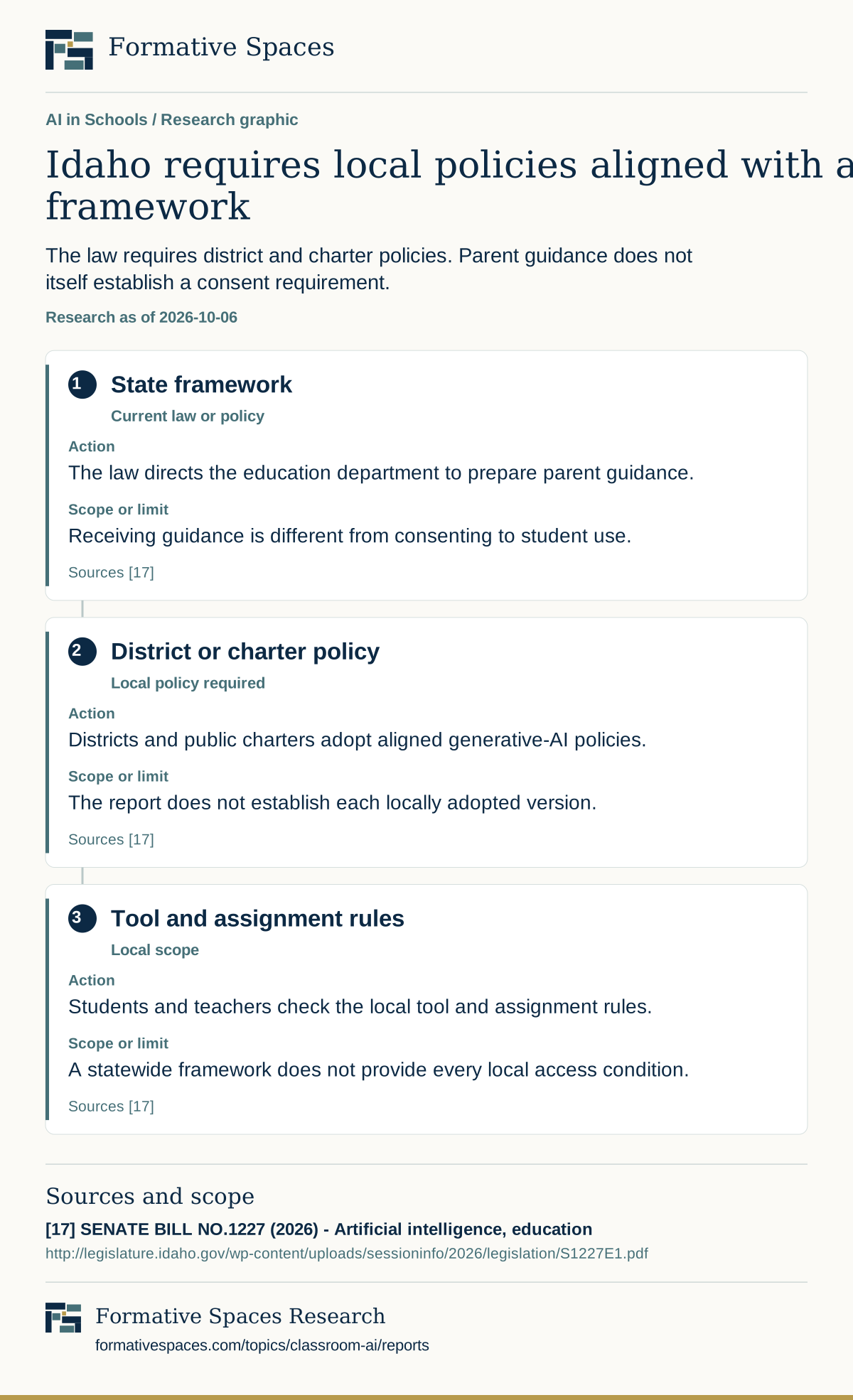
Idaho also requires local action, with districts and public charter schools directed to align their generative-AI policies with a statewide framework. Its law took effect July 1, 2026. It directs the state education department to prepare guidance for parents and guardians. Receiving that guidance and consenting to a child’s use are different events. A family still needs the local policy to understand approved tools and classroom conditions. The framework supplies a starting point for that inquiry. 17
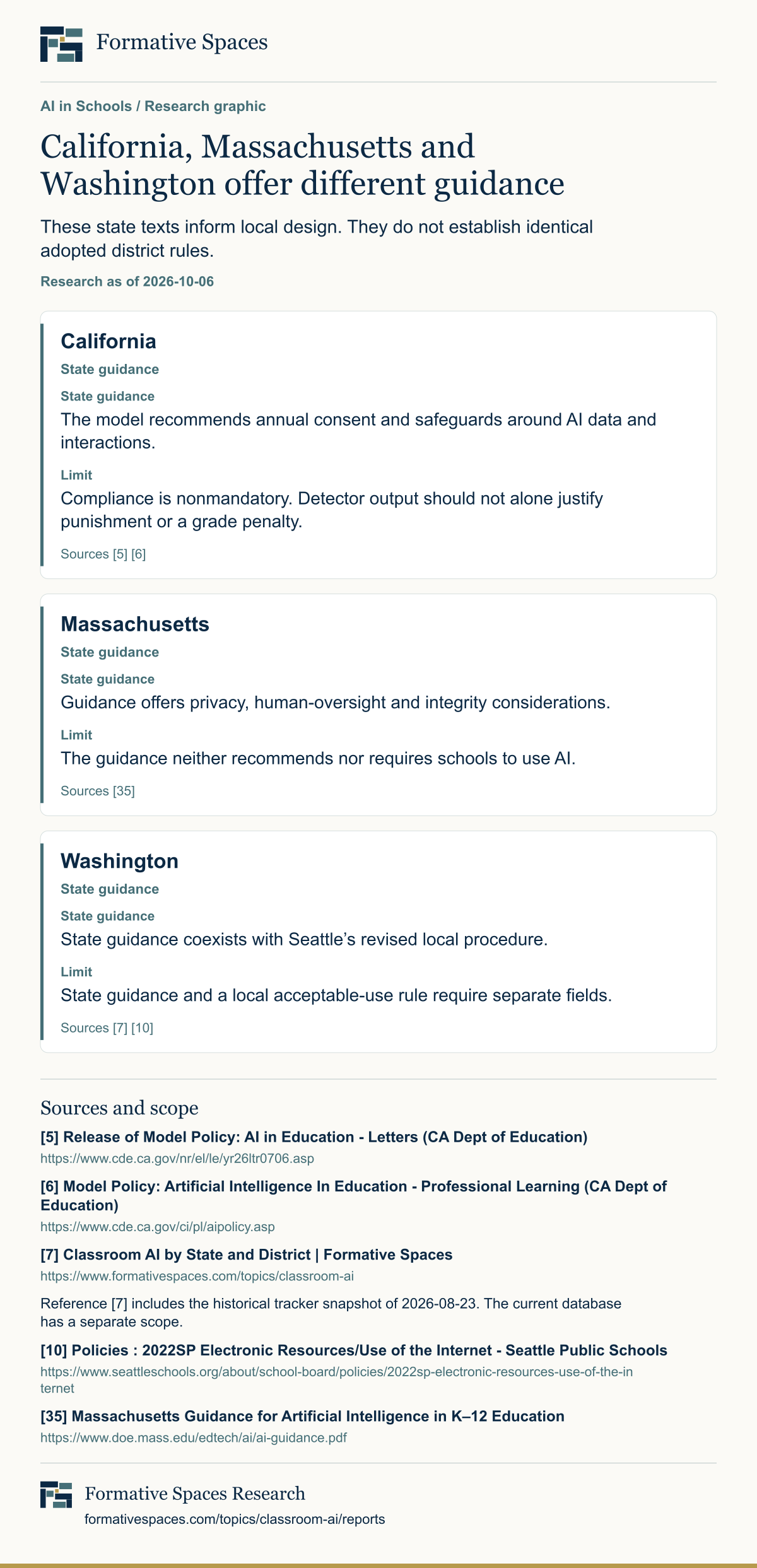
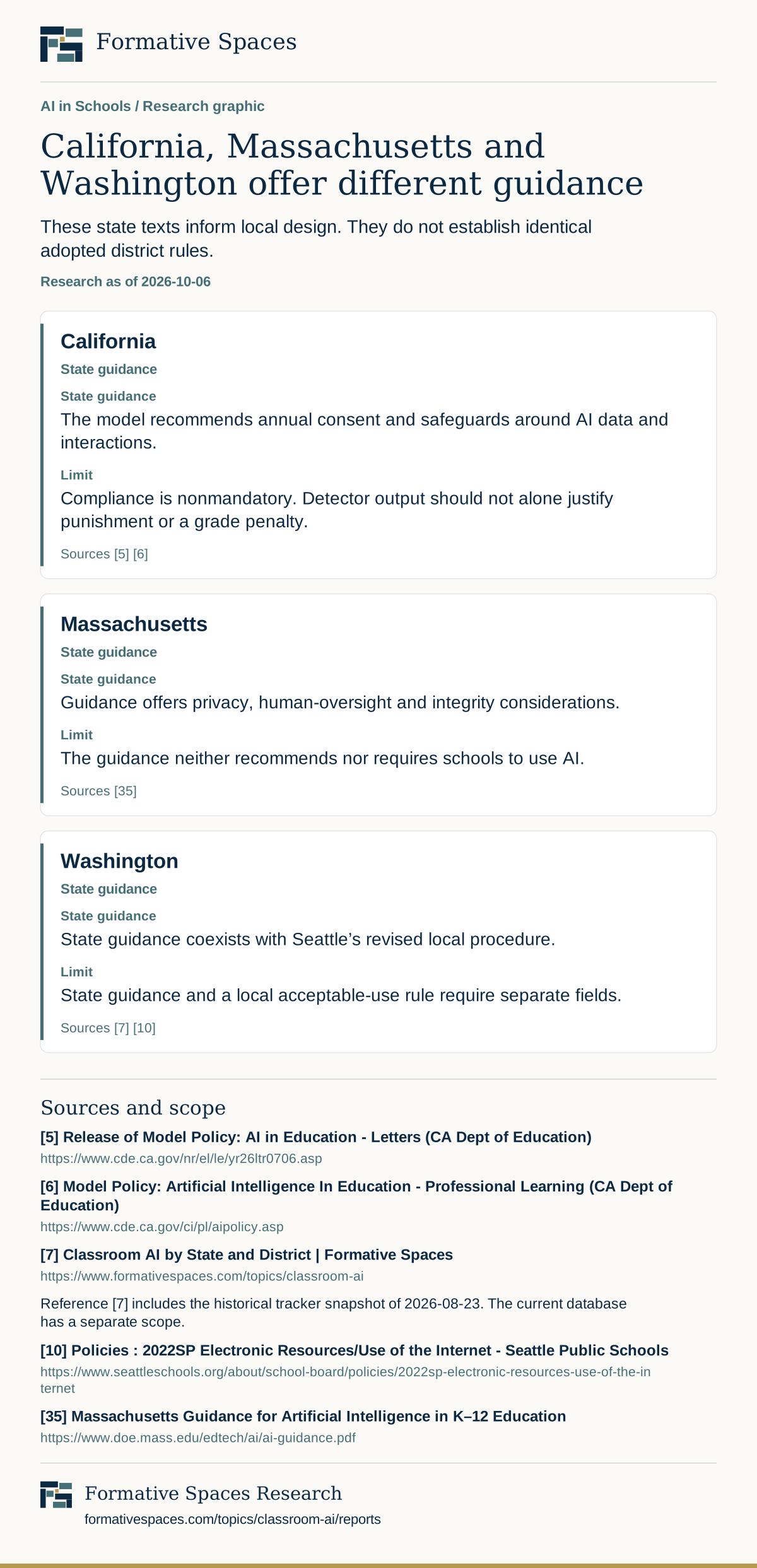
California and Massachusetts illustrate the limits of treating guidance as a uniform requirement. California’s June 2026 model expressly says compliance is not mandatory. Massachusetts says its guidance neither recommends nor requires schools to use AI. Both can inform local choices about privacy, oversight and academic integrity. Their existence does not show which district adopted which safeguards. A reader comparing jurisdictions needs to know whether a document requires an action, recommends one or records a local choice. 5 6 3545
Parents can consent, opt out or receive a notice
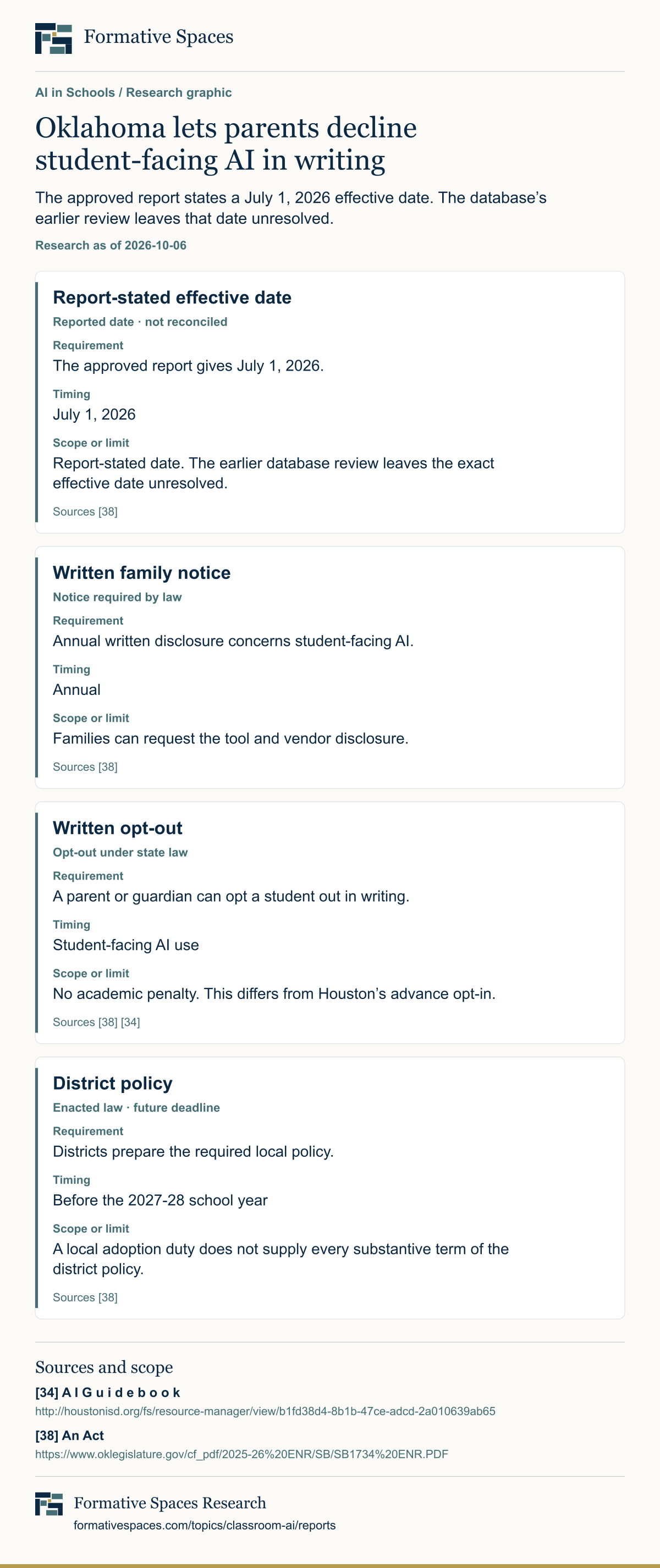
Family choice varies even among documents that address it directly. Houston requires advance written consent for qualifying access by students in eighth grade and above. Oklahoma’s statute permits parents or guardians to decline student-facing AI in writing without an academic penalty. It also calls for educator-directed use and annual written disclosure to parents. A parent seeking a choice faces different procedures in these two settings. One gives advance permission. The other uses a written opt-out. 34 38
Oklahoma’s local-policy requirement applies before the 2027–28 school year. Families should be able to identify the disclosure and the written opt-out channel in the applicable policy. 3846
Other consent provisions cover narrower circumstances. Utah’s statute requires written parental consent for specified AI sandbox courses. That does not establish the same requirement for every ordinary classroom use. California’s optional model recommends annual consent for specified AI-driven data collection or autonomous interactions. The scope of the activity and the authority of the document are part of the family choice itself. 5 6 2047
Family choice takes five different forms55

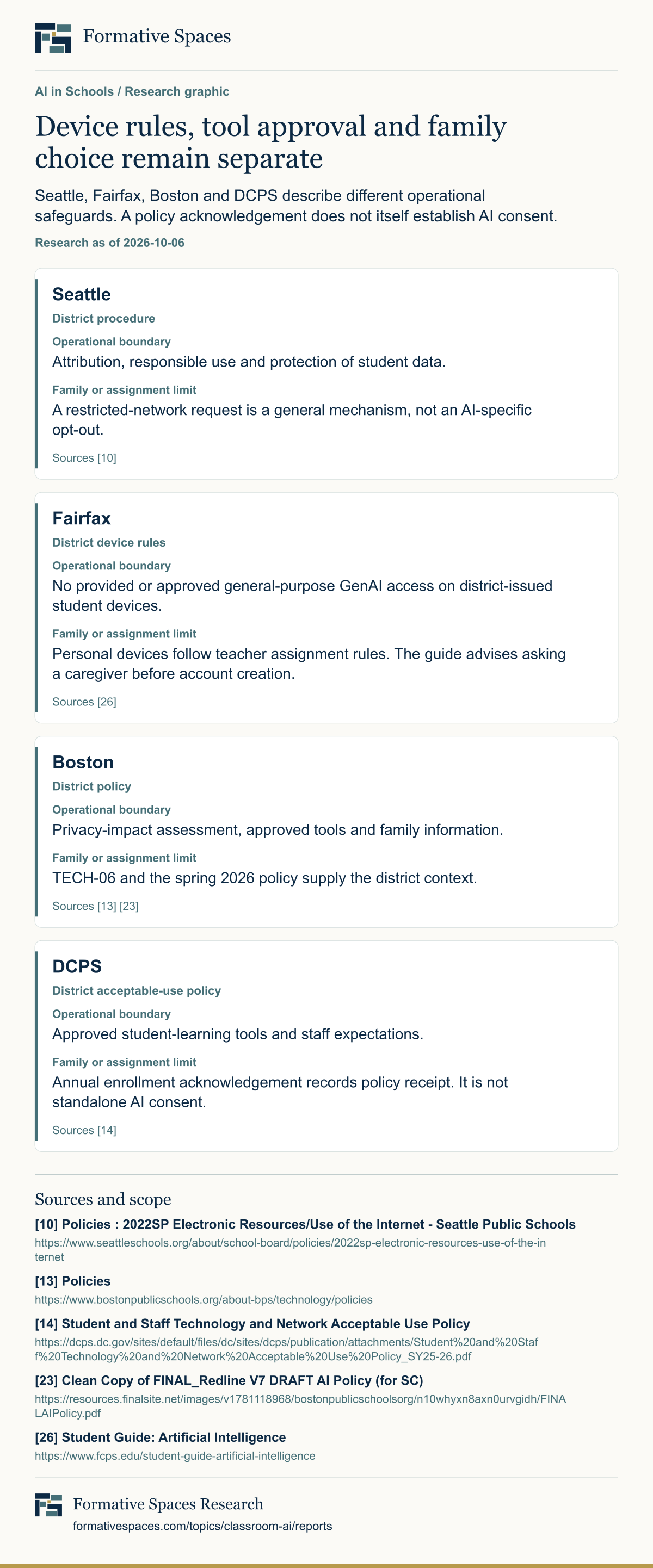
Seattle offers a different mechanism through its network rules. A family can request a restricted network group, but that is a general network choice rather than an AI-specific opt-out. The district’s 2024–25 AI pilot involved five high schools and two middle schools. That limited, dated pilot does not describe current access for every Seattle student. A family looking for today’s conditions needs the current district procedure and the scope of the requested network restriction. 10 12
Device and account rules add further distinctions. Fairfax’s guide says the district does not provide or approve student general-purpose generative AI on district-issued devices. For personally owned devices, students should first check the teacher’s assignment rules and ask a caregiver before creating an account. DCPS includes approved student-learning tools in its acceptable-use policy. Its annual enrollment acknowledgement records receipt of the policy. That acknowledgement alone cannot be reported as a separate AI consent form. 14 26
Boston’s cited policies call for privacy impact assessment, approved tools and family information. Those steps can help a family understand the district’s choices, but information and permission serve different purposes. A useful explanation names the tool, the eligible student and the applicable choice procedure. It also identifies who can answer a question about data or account access. Families should be able to locate those details without assuming that a general technology notice resolves every AI decision. 13 23 34 38
Policies reserve grades and discipline for people
A second set of limits concerns the decisions schools make about students. New York City’s cited guidance reserves grading, placement and discipline for qualified humans. That boundary reaches beyond whether a student can use a chatbot to help with work. Product approval also carries a student-data safeguard: vendors cannot use that data to train models. A family evaluating a tool needs both pieces. Permission to use a service and authority to make a consequential decision are separate questions. 8
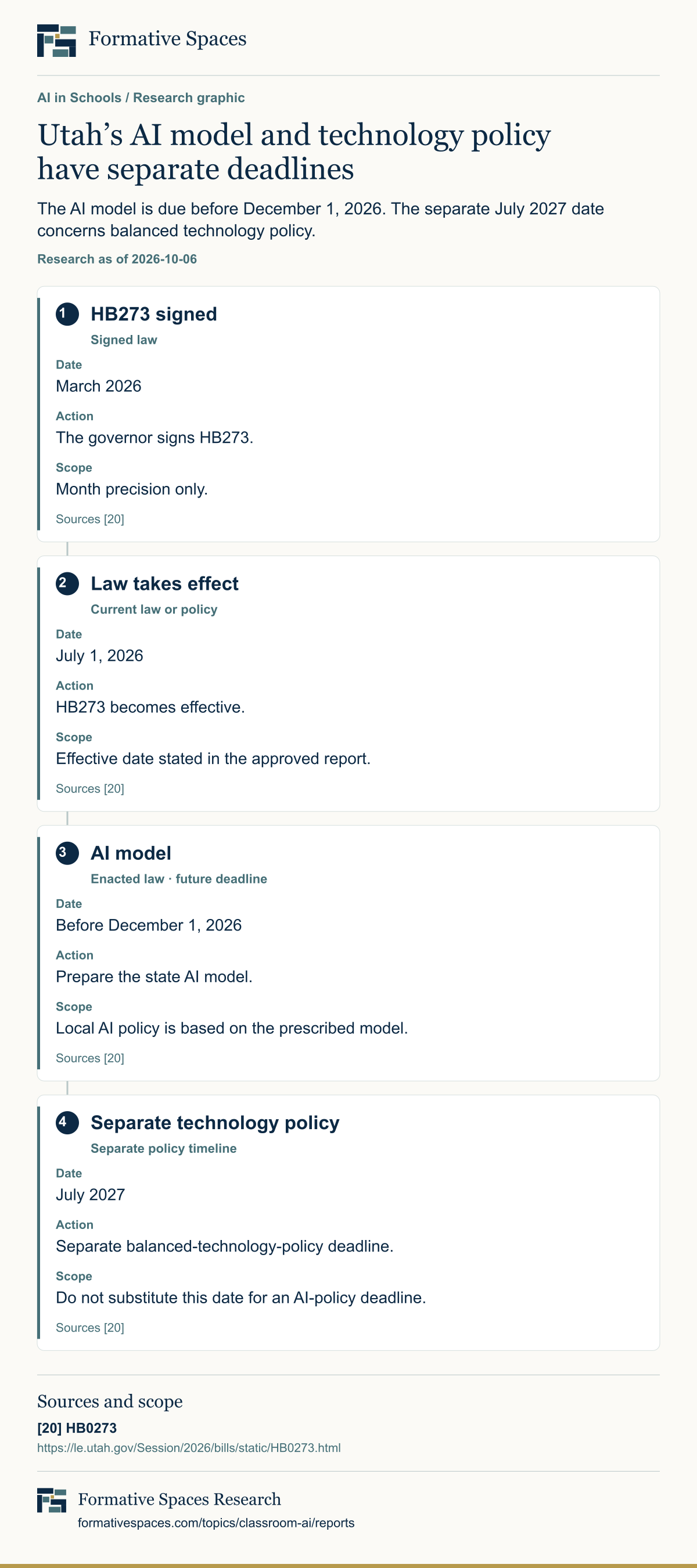
Utah’s law takes a related but distinct route through a required state model. That model must prohibit students from using AI on academic assignments unless an educator authorizes the specific assignment. It must also bar educators from independent AI grading or high-stakes determinations. The state model is due before December 1, 2026, and local education agencies must base policies on it. These prescribed terms do not establish that every agency has already adopted its completed policy. 20
Virginia requires school boards to establish, implement and enforce policies consistent with state guidance. Its framework addresses vendor use of student information for model training, human judgment in consequential decisions and teacher access to approved instructional AI transcripts. The transcript provision makes oversight more specific than a general promise that adults remain involved. It identifies information a teacher can review when AI supports instruction. The cited framework still needs to be read alongside the board’s applicable local policy. 19
NYC, Utah and Virginia set different limits on AI decisions56

Academic misconduct is another decision where the distinction matters. Chicago’s student rules call for investigation of suspected AI misuse. Suspicion alone does not become an automatic conclusion in that process. California’s optional model says AI-detector output should not be the sole basis for punishment or a grade penalty. These provisions address how a school reaches a judgment. A list of approved tools, by itself, cannot explain the procedure a student faces when a school questions work. 4 6
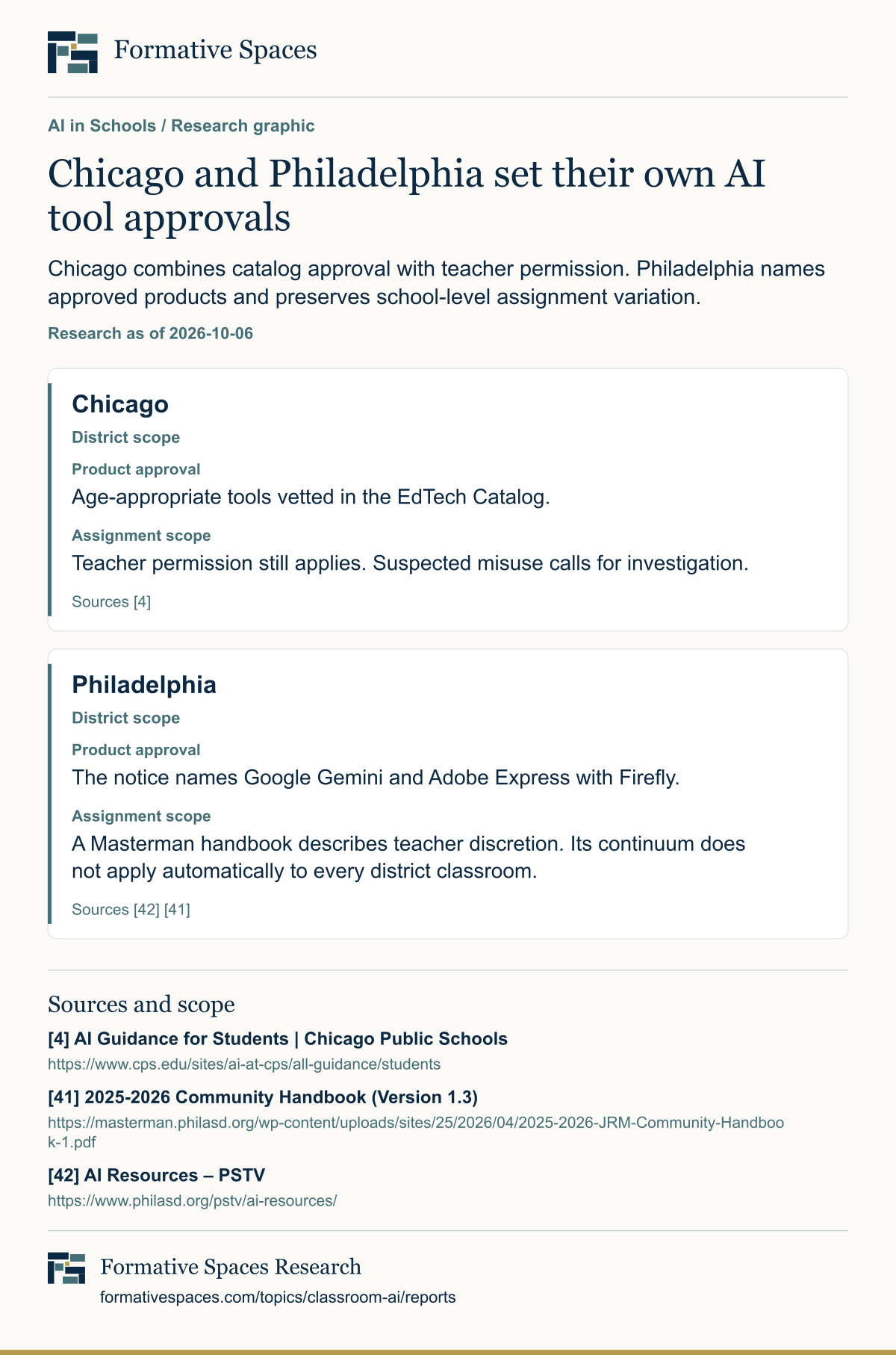
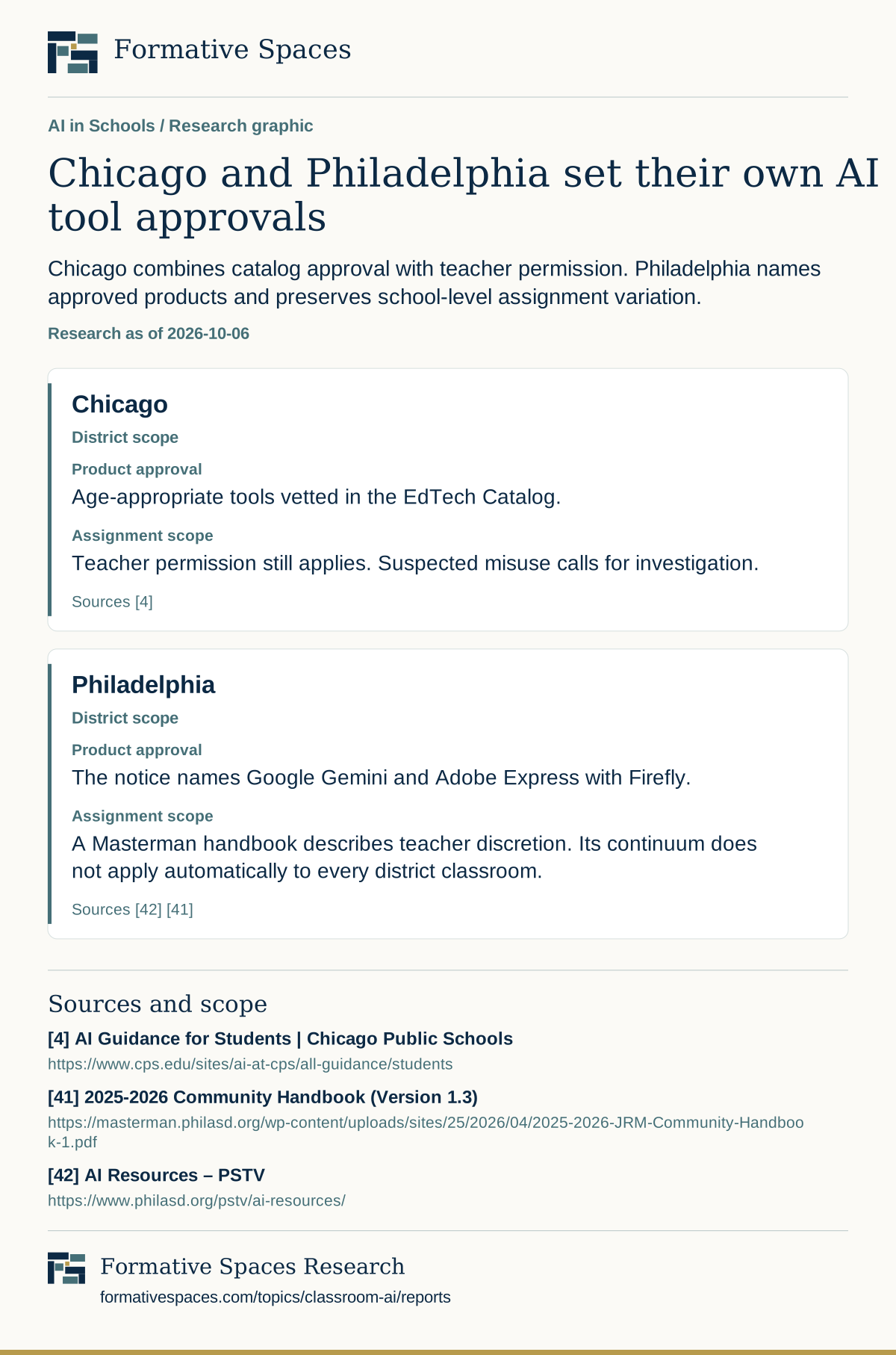
Product approval is also more specific than a general statement that schools allow AI. Chicago directs students to its vetted EdTech Catalog and teacher permission. Philadelphia names Google Gemini and Adobe Express with Firefly as approved tools. Its guidance treats unapproved tools used for district work as an acceptable-use violation. At Philadelphia’s Masterman school, the cited handbook adds a continuum of teacher discretion. That school-level detail cannot be applied to every Philadelphia classroom. 4 41 42
States set different deadlines for policy and training
The next decisions will arrive on different schedules. North Carolina’s enacted framework calls for a state model by December 31, 2026, followed by distribution by January 15, 2027. Public school units must adopt policies by June 30, 2027. Specified teacher professional development follows by June 30, 2028. These are four stages with different actors and purposes. The model deadline does not establish completed local policies or completed teacher training. 39 4348
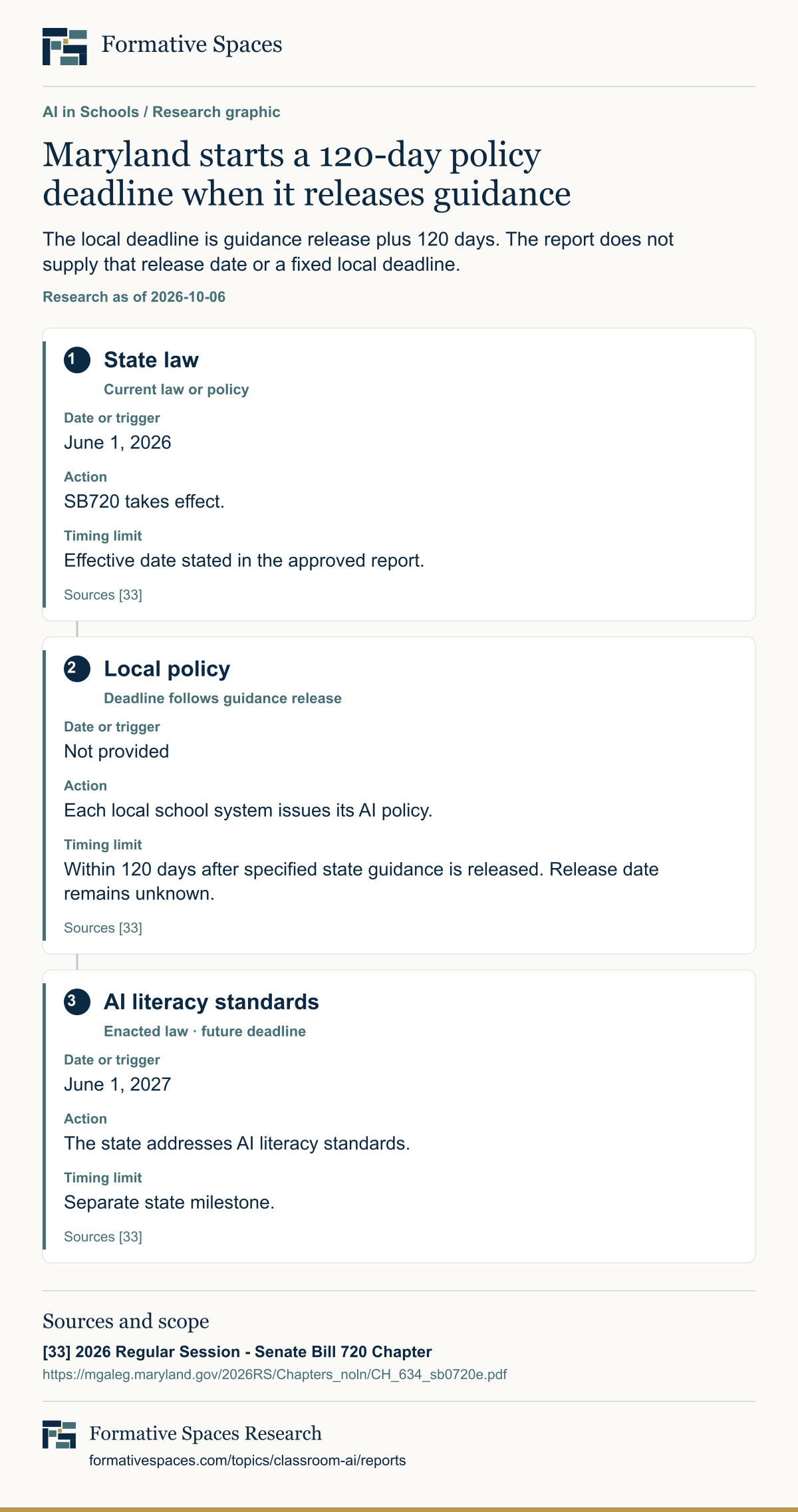
Maryland uses a relative deadline. Its law took effect June 1, 2026 and requires local school systems to issue a policy within 120 days after the state releases specified guidance. The law also requires an AI coordinator and addresses AI literacy standards by June 1, 2027. A local calendar needs the guidance’s actual release date as well as the statute. 3349
North Carolina sets four distinct milestones57

Utah’s dates also need to remain separate. Its state AI model is due before December 1, 2026. A distinct balanced-technology policy requirement has a July 2027 deadline. Those obligations address related school technology decisions, but the later date does not replace the earlier AI-model duty. Families asking what applies to an assignment need the relevant AI policy. School leaders planning adoption need to identify which policy each date governs before using it in a calendar. 20
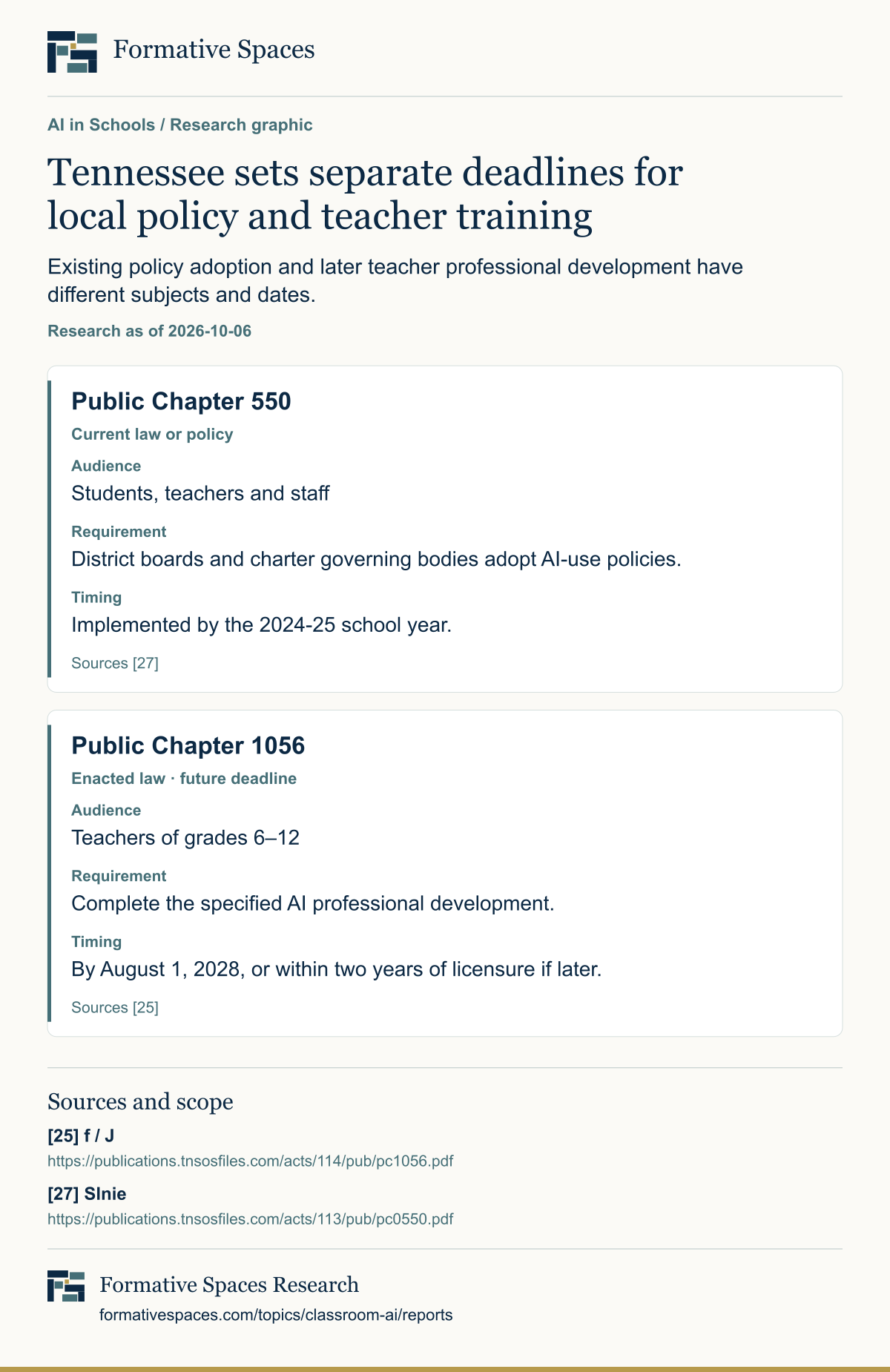
Tennessee combines an existing local-policy duty with later teacher training. Public Chapter 550 required district boards and charter governing bodies to implement AI-use policies by the 2024–25 school year. Those policies cover students, teachers and staff. Public Chapter 1056 sets a separate training deadline for teachers of grades six through 12. It is August 1, 2028, or within two years of licensure if that is later. The later training date does not delay the earlier policy requirement. 25 27
Florida shows how quickly a dated category can become incomplete. The August tracker placed the state in its no-statewide-rule category. On September 16, 2026, the state education department announced the board’s adoption of AI rules and described parent notice and opt-in. That announcement records a change after the snapshot. 7 18 29 3650
A proposed Florida amendment includes a July 1, 2027 deadline for local internet-safety policies, parent choice and transcript-retention language. The proposed date cannot yet be treated as an operative deadline from these sources. Families need the district’s current practice, while leaders need the filed final rule before treating those proposed terms as binding. 9 18 29 3651
Florida announced AI rules. Final terms remain unresolved58

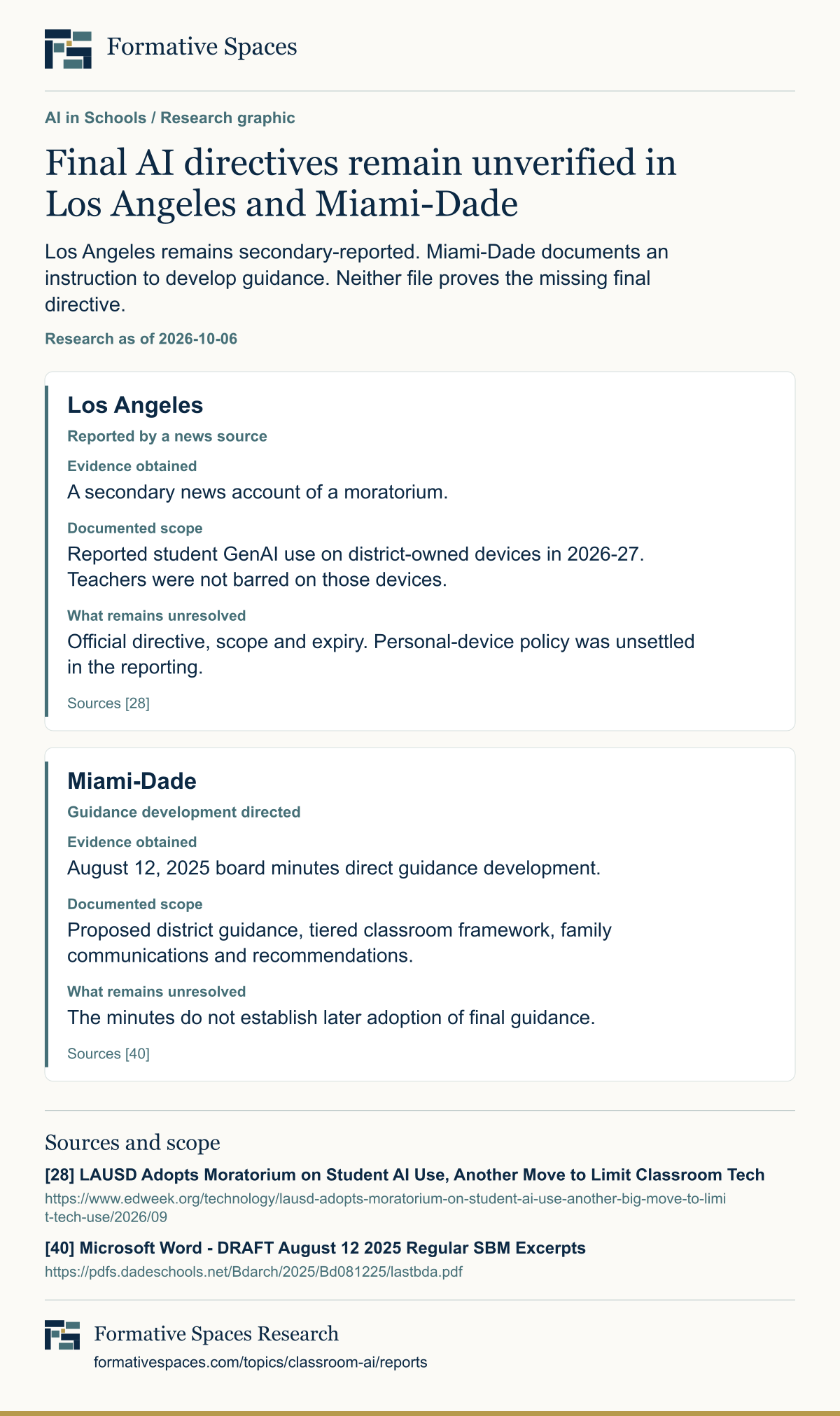
Some local stories require the same care about the evidence. The Los Angeles account reports a 2026–27 moratorium on student generative-AI use through district-owned devices. It also reports that teachers could still use generative AI on district-owned devices, while policy for personal devices remained unsettled. 2852
Miami-Dade’s evidence records an earlier point in policy development. Its August 12, 2025 board minutes direct the superintendent to develop guidance, a tiered classroom framework and family communications, then report recommendations. That instruction establishes a development process. It does not establish that the resulting guidance was later adopted. A reader can learn what the board asked for without assuming that the requested framework now controls classroom use. The next relevant document would be the resulting guidance or adoption record. 40
For a family, the most useful policy search starts with the district and the student’s actual use. Which tool does the district approve? Does the rule cover this grade and device? Does the rule require written consent, or can the student decline through a specified process? Who decides a grade or resolves a concern? Houston, New York City, Oklahoma and Seattle supply different answers to parts of that search. A family moving between them needs to check the new local conditions. 8 10 34 38
For teachers and school leaders, the same search connects an approved service to the work teachers ask students to do. The current catalog, account rules, assignment instructions and human-review procedure each answer a different part of the question. A state policy headline can point readers toward a law or guidance. The local documents show how that authority reaches a student. Clear dates and visible source limits make those connections easier to follow as school AI policy continues to change. 4 8 26 34 42
More charts from this research
These charts are available in the reference reports and as branded downloads.
- Houston separates authority, approval and assignment permissionPNG · SVG
- Maryland starts a 120-day policy deadline when it releases guidancePNG · SVG
- Utah’s AI model and technology policy have separate deadlinesPNG · SVG
- Ohio requires local policies. Its sample terms are optionalPNG · SVG
- Idaho requires local policies aligned with a frameworkPNG · SVG
- Illinois guidance and Chicago approval are different decisionsPNG · SVG
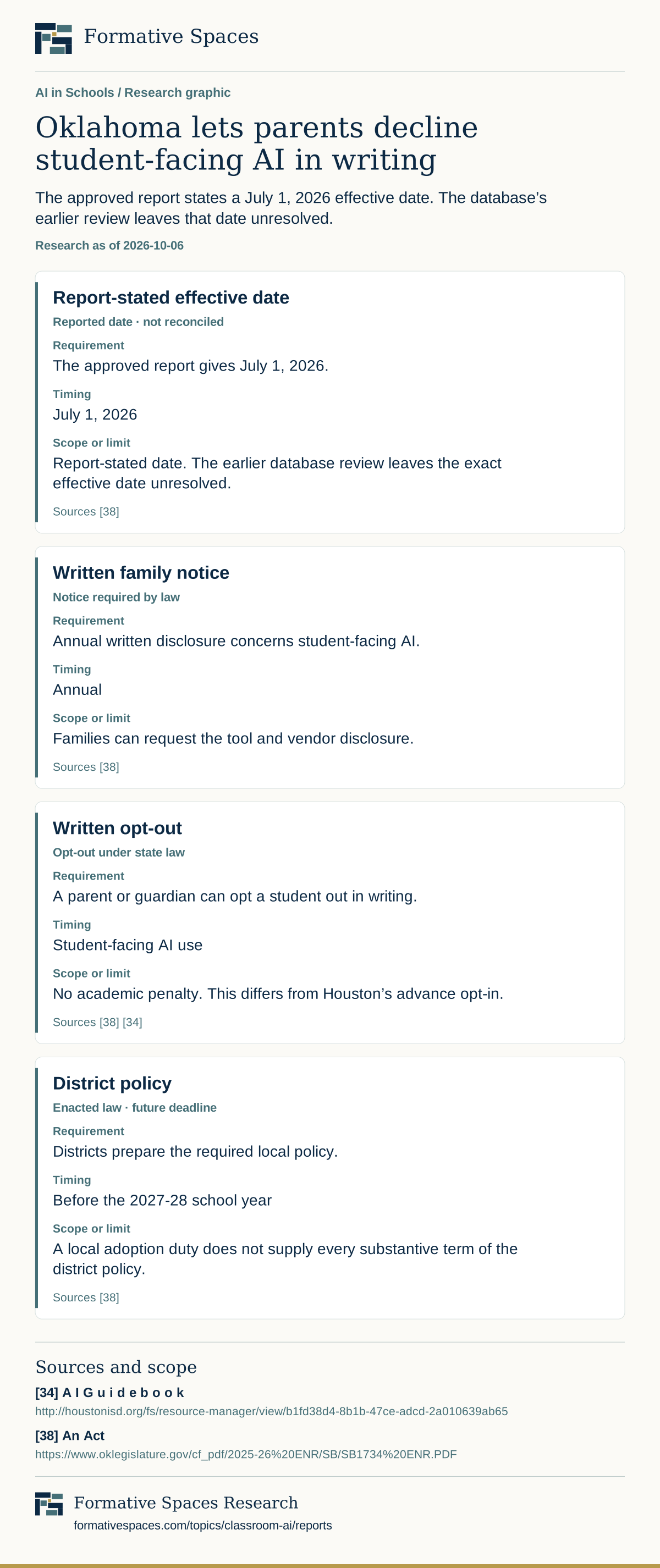
- Oklahoma lets parents decline student-facing AI in writingPNG · SVG
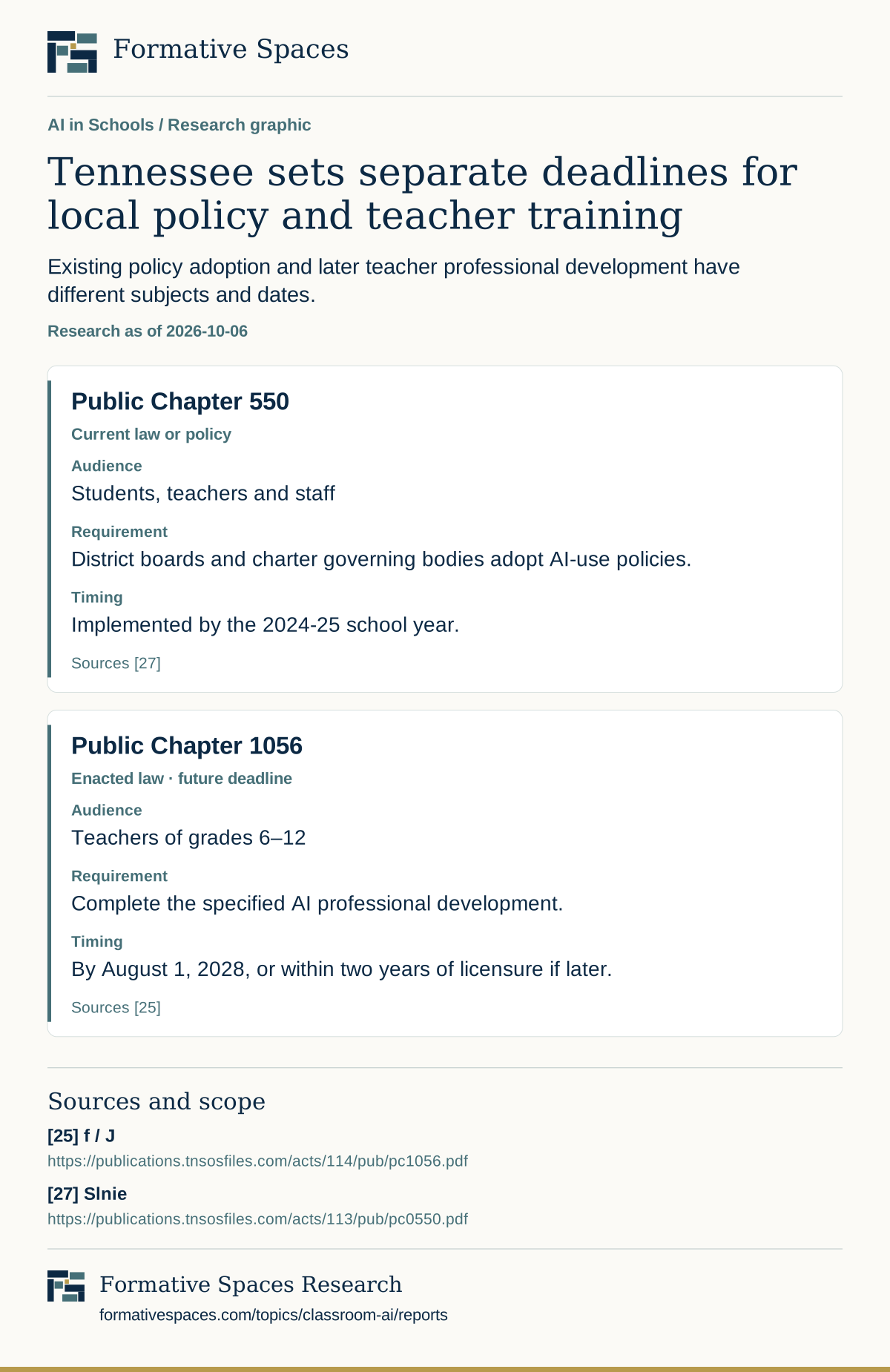
- Tennessee sets separate deadlines for local policy and teacher trainingPNG · SVG
- California, Massachusetts and Washington offer different guidancePNG · SVG
- NYC reviews products before use with student dataPNG · SVG
- Houston sets separate AI rules by grade and assignmentPNG · SVG
- Chicago and Philadelphia set their own AI tool approvalsPNG · SVG
- Device rules, tool approval and family choice remain separatePNG · SVG
- Final AI directives remain unverified in Los Angeles and Miami-DadePNG · SVG
Share this article
Download a branded preview or share the article link.
Related reporting
California law bars ed-tech use of student data for AI training, extends privacy rules to colleges
AB 1159 prohibits companies from using identifiable student information to train generative AI and broadens California's school privacy laws to cover higher education, closing a loophole that let general platforms escape regulation.
Massachusetts Graduation Council Recommends AI Literacy as Required Milestone
Final advisory report filed June 2026 proposes AI and digital literacy module within career-planning framework; legislative action still needed before any class graduates under new standards.
LAUSD bars student generative AI on district devices for 2026-27, surprising board and parents
The nation's second-largest school district imposed a moratorium on student access to generative AI tools, affecting 378,000 students. The move was disclosed at a committee meeting without a board vote, as the district studies how to regulate the technology.
Sources and footnotes
This article reflects research as of October 6, 2026. Reference numbers link to the cited publications. The narrative draws on the source material retained in the state and district reports.
The August tracker counts describe its historical snapshot. The reviewed policy database has a separate scope and release date. Neither is a census of classroom AI use.
Limits and source differences
- The approved paragraph attributes this account to the Los Angeles Times. Reference 28 links to Education Week. The attribution remains unresolved. [28]
- Reference 43 is a legislative summary. The approved text identifies SL2026-61 as an amendment. The package has no separate full-text amendment link. [39][43]
- This report gives July 1, 2026, from the supplied research. The database’s earlier review leaves the effective date unresolved. [38]
- This report uses March 2026 NYC guidance. The database uses a separate 2026–27 student directive. Their dates and scope must remain distinct. [8]
- The state counts and 82 district policies describe the August 23, 2026 tracker. They do not replace the current 24-record research release. [7]
- [8][34]
This comparison uses NYC’s March guidance. The database separately records a 2026–27 student directive, whose date and scope remain distinct.
- [7]
The current reviewed database has a different purpose from the August tracker. It contains 24 selected instruments. Research is partial in 15 state jurisdictions and not assessed in 36, across the same 51-jurisdiction frame. Those labels describe our research coverage, not the presence or absence of AI policy. A jurisdiction outside this reviewed selection can still have a relevant law or district rule. The database and the historical tracker therefore answer different questions, with different dates and limits.
- [38]
The supplied research gives July 1, 2026 as the statute’s effective date. The database’s earlier review leaves that date unresolved. We retain that disagreement rather than silently joining the two accounts. It does not change the need to distinguish the statute’s family-choice provisions from the separate local-policy timetable.
- [5][6][20]
A recommendation in that model cannot become a statewide mandate through a chart label.
- [32][39][43]
The supplied report identifies section 7.39 of Session Law 2026–41, amended by Session Law 2026–61, as the enacted framework. Its amendment reference is a legislative summary, without a separate full-text amendment link in the supplied research. That source limit remains visible here. House Bill 301’s cited conference-committee history is a different record. It cannot substitute for the enacted schedule when a family or school leader looks for the authority behind these dates.
- [33]
The cited research does not establish that release date, so it cannot supply a fixed local deadline.
- [7][18][29][36]
The accessible code entry still points to an older final version and a September 18 change notice. Those materials do not establish the new rule’s exact final text or effective date.
- [9][18][29][36]
The useful account holds both findings together: the agency announced adoption, and the precise final requirements remain unresolved in the cited research.
- [28]
The supplied research did not recover an official directive. The original text attributes the account to the Los Angeles Times, but its reference links to Education Week. That attribution remains unresolved.
- 30 of 51 jurisdictions had AI guidance in August: These counts describe the August 23, 2026 tracker. They do not describe the current database or every district.State law: Jurisdictions: 9. State guidance: Jurisdictions: 30. No statewide rule: Jurisdictions: 12. [7]
- State AI policy alone does not approve a classroom tool: Federal protections, state authority, district approval and teacher instructions address different decisions. A state policy alone does not approve a classroom tool.Federal baseline: Action: Literacy initiatives and student-record protections.; Scope or limit: No approval of an individual classroom tool.. State authority: Action: Enacted duties or recommended model language, according to the document.; Scope or limit: A state model does not approve every local vendor.. District implementation: Action: Local policy, account permissions and classroom procedures.; Scope or limit: Local rules cannot waive state or federal protections.. Approved product and account: Action: Check the district product list and account conditions.; Scope or limit: A generic AI permission does not approve every service.. Teacher assignment: Action: Check whether and how an approved tool may assist particular work.; Scope or limit: Assignment permission cannot bypass age, account or data restrictions.. Student access: Action: The tool, account, student eligibility and task must meet the applicable conditions.; Scope or limit: Permission from one district does not transfer to another.. [1][4][5][8][11][16][26][34][38]
- Family choice takes five different forms: Oklahoma opt-out, Houston opt-in, Utah sandbox consent, California recommendations and Seattle network requests differ in authority and scope.Oklahoma: Mechanism: Written opt-out; Authority level: State statute; When it applies: Student-facing AI use; Who initiates it: Parent or guardian; What it covers: A student can decline the use in writing without academic penalty.. Houston: Mechanism: Written parental consent / opt-in; Authority level: District guide; When it applies: Qualifying access in eighth grade and above; Who initiates it: Not provided; What it covers: Approved educational tasks also need prior teacher permission.. Utah: Mechanism: Written parental consent; Authority level: State law, specified sandbox context; When it applies: Specified AI sandbox courses; Who initiates it: Not provided; What it covers: The report does not extend the requirement to every ordinary classroom use.. California: Mechanism: Annual consent recommendation; Authority level: Nonbinding state model; When it applies: AI-driven collection and autonomous interactions; Who initiates it: Not provided; What it covers: A model recommendation. Local adoption is not established.. Seattle: Mechanism: Restricted-network request; Authority level: General district network procedure; When it applies: A family requests a restricted-access group; Who initiates it: Family; What it covers: General network access. This is not an AI-specific opt-out.. [5][6][10][20][34][38]
- NYC, Utah and Virginia set different limits on AI decisions: NYC reserves decisions for qualified humans. Utah prescribes limits in model language. Virginia requires safeguards for consequential decisions.New York City: Authority: District March 2026 guidance; Human-decision safeguard: Grading, placement and discipline remain with educators or other qualified humans.; Scope: March guidance used in this report. The database’s separate 2026–27 directive has its own scope.. Utah: Authority: HB273 prescribed model; Human-decision safeguard: The model bars educators from independent AI grading or high-stakes determinations.; Scope: Required model language. The report does not establish individual local adoption.. Virginia: Authority: Updated state education code; Human-decision safeguard: Safeguards preserve human judgment in consequential decisions.; Scope: School-board policies must follow department guidance.. [8][19][20]
- North Carolina sets four distinct milestones: The approved research cites enacted section 7.39 and its amendment. Reference 43 is a legislative summary, rather than full amendment text.State model: Deadline: December 31, 2026; Required action: Prepare the state model.; Scope: State model development. Distribution: Deadline: January 15, 2027; Required action: Distribute the model.; Scope: Separate distribution milestone. Local policies: Deadline: June 30, 2027; Required action: Public school units adopt policies.; Scope: Local implementation. Teacher training: Deadline: June 30, 2028; Required action: Complete specified professional development.; Scope: Specified teacher training. [39][43]
- Florida announced AI rules. Final terms remain unresolved: The agency announced adopted rules. The reviewed final wording, effective date and proposed July 2027 deadline remain unresolved.August classification: Date: August 23, 2026; Event or term: The tracker lists no statewide classroom-AI rule.; Evidence limit: Historical classification, before the later announcement.. Agency announcement: Date: September 16, 2026; Event or term: The department announces board adoption of AI rules.; Evidence limit: Announced adoption. Final operative text remains unverified.. Notice of change: Date: September 18, 2026; Event or term: A notice of change appears.; Evidence limit: The accessible code entry still points to an older final version.. Draft local deadline: Date: July 1, 2027; Event or term: A proposed amendment includes a local internet-safety-policy deadline.; Evidence limit: Proposed text. Do not treat this as an operative deadline.. Final effective date: Date: Not provided; Event or term: Filed final text and legal commencement need verification.; Evidence limit: The report does not establish an effective date.. [7][9][18][29][36]
- FERPA | Protecting Student Privacystudentprivacy.ed.gov
- Artificial Intelligence Guidancewww.isbe.net
- Public Acts - 104-0399www.ilga.gov
- AI Guidance for Students | Chicago Public Schoolswww.cps.edu
- Release of Model Policy: AI in Education - Letters (CA Dept of Education)www.cde.ca.gov
- Model Policy: Artificial Intelligence In Education - Professional Learning (CA Dept of Education)www.cde.ca.gov
- Classroom AI by State and District | Formative Spaceswww.formativespaces.com
- Guidance on Artificial Intelligencewww.schools.nyc.gov
- 6A-1www.fldoe.org
- Policies : 2022SP Electronic Resources/Use of the Internet - Seattle Public Schoolswww.seattleschools.org
- DCPD202500511www.govinfo.gov
- Artificial Intelligence FAQs - Seattle Public Schoolswww.seattleschools.org
- Policieswww.bostonpublicschools.org
- Student and Staff Technology and Network Acceptable Use Policydcps.dc.gov
- Guidance vs. 3.docxoklahoma.gov
- AI in Education: Model Policy for Ohio Districts and Schoolseducation.ohio.gov
- SENATE BILL NO.1227 (2026) - Artificial intelligence, educationlegislature.idaho.gov
- 6A-1.0957 : Internet Safety Policy - Florida Administrative Rules, Law, Code, Register - FAC, FAR, eRulemakingflrules.org
- Code of Virginia (2026 Updates)law.lis.virginia.gov
- HB0273le.utah.gov
- 2026 Regular Session - Senate Bill 720 Enrolledmgaleg.maryland.gov
- SENATE BILL 514 By Bailey HOUSE BILL 531 By Farmer AN ACT to amend Tennessee Code Annotated, Title 49, relativecapitol.tn.gov
- Clean Copy of FINAL_Redline V7 DRAFT AI Policy (for SC)resources.finalsite.net
- GENERAL ASSEMBLY OF NORTH CAROLINA SESSION 2025 SESSION LAW 2025-38 HOUSE BILL 959 AN ACT TO PROMOTE INTERNET SAFETY, TOwww.ncleg.gov
- f / Jpublications.tnsosfiles.com
- Student Guide: Artificial Intelligencewww.fcps.edu
- Slniepublications.tnsosfiles.com
- LAUSD Adopts Moratorium on Student AI Use, Another Move to Limit Classroom Techwww.edweek.org
- Florida Sets National Standard for Responsible AI in Classrooms—From VPK Through CollegeFlorida Sets National Standard for Responsible AI in Classrooms—From VPKwww.fldoe.org
- Artificial Intelligence (AI) in K12 Schools - Educational ...www.doe.mass.edu
- Bill Information - Tennessee General Assemblywapp.capitol.tn.gov
- House Bill 301 (2025-2026 Session) - North Carolina General Assemblyncleg.gov
- 2026 Regular Session - Senate Bill 720 Chaptermgaleg.maryland.gov
- A I G u i d e b o o khoustonisd.org
- Massachusetts Guidance for Artificial Intelligence in K–12 Educationwww.doe.mass.edu
- 31384852, 6A-1.0957 - Florida Administrative Rules, Law, Code, Register - FAC, FAR, eRulemakingflrules.org
- Bill Informationwww.oklegislature.gov
- An Actwww.oklegislature.gov
- SL 2026-41 (SB 257)www.ncleg.gov
- Microsoft Word - DRAFT August 12 2025 Regular SBM Excerptspdfs.dadeschools.net
- 2025-2026 Community Handbook (Version 1.3)masterman.philasd.org
- AI Resources – PSTVwww.philasd.org
- 2026 Appropriations Act.dashboard.ncleg.gov